Uni-Probe LB 490
BERTHOLD TECHNOLOGIES GmbH & Co. KG
2 – 147
Volume 2 2 Installation
2
2.4 Detector Installation
Make sure that
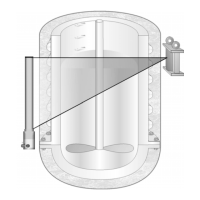
– the detector or the source fixtures do not obstruct the beam
path.
– there are no pipes, flanges, stirrers or other installations in the
beam path.
Only installations that have already been known when planning the
measurement configuration are permitted. Otherwise, the curve is
no longer linear; there may even be sections in the measurement
range where the measured values do not change.
2.4.1 Rod Detector with and without Water Cooling
Function failure due to damaged detector
The detector fixture must not transfer any vibrations or heat onto
the detector; otherwise the detector will be disturbed or may fail
altogether.
Therefore, install the fixture on a vibration-free support or attenu-
ate possible vibrations using vibration absorbers. Make sure to pre-
vent heat transfer to the detector via the detector fixture by using
suitable insulating materials.
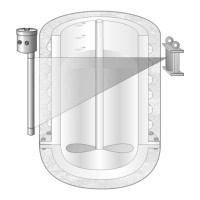
The rod detector is mounted vertically on the outside of the vessel.
The top point of the effective detector length is marked by a
groove, which also defines the top point of the measuring range
that can be covered. Please note the dimensional drawings of the
rod detector (page 2–254).
The rod detector is mounted as shown in Figure 2-2, with one fixing
clamp outside the marking grooves. The distance from the center
of the detector to the surface of the vessel or the surface of a ther-
mal insulation is about 100mm. The clamps have to be arranged so
that no heat is transferred to the detector.


 To Next Page