202
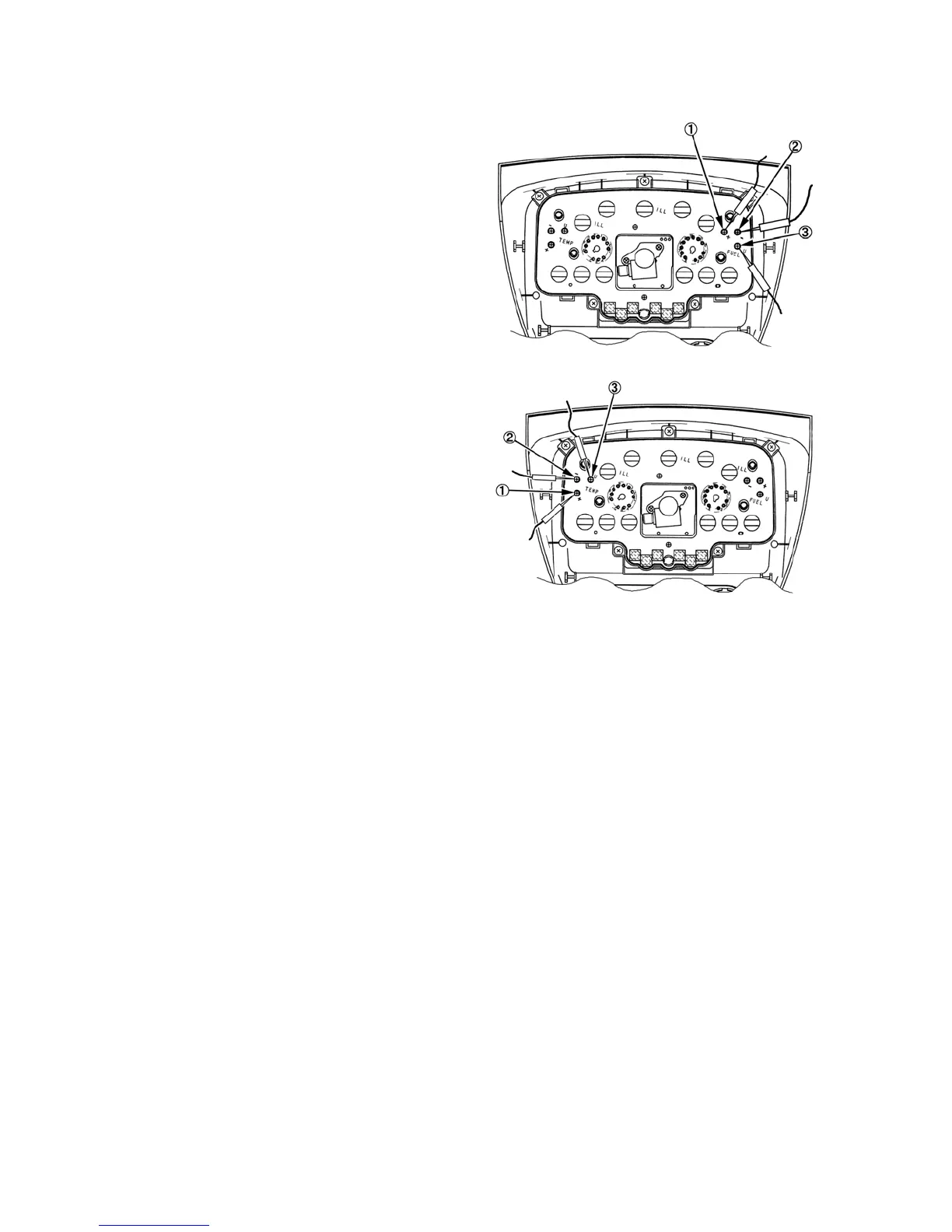
Fuel Gauge Testing
1. Disconnect the instrument panel
connector from the main wiring harness.
2. Using an ohmmeter, touch one test probe
to the “+” terminal, 1, of the fuel gauge
and touch the other test probe to the “-”
terminal, 2, of the fuel gauge.
3. Observe the ohmmeter. The measured
resistance should be about 88 ohms. If
resistance is not this specification, the
gauge is defective and the instrument
panel needs replaced.
4. Using an ohmmeter, touch one test probe
to the “+” terminal of the fuel gauge
and touch the other test probe to the
“U” terminal of the fuel gauge.
5. Observe the ohmmeter. The measured
resistance should be about 72 ohms. If
resistance is not this specification, the
gauge is defective and the instrument
panel needs replaced.
Temperature Gauge Testing
1. Disconnect the instrument panel
connector from the main wiring harness.
2. Using an ohmmeter, touch one test probe
to the “+” terminal, 1, of the
temperature gauge and touch the other
test probe to the “-” terminal, 2, of the
temperature gauge.
3. Observe the ohmmeter. The measured
resistance should be about 88 ohms. If
resistance is not this specification, the
gauge is defective and the instrument
panel needs replaced.
4. Using an ohmmeter, touch one test probe
to the “+” terminal, 3, of the
temperature gauge and touch the other
test probe to the “U” terminal, 3, of the
temperature gauge.
5. Observe the ohmmeter. The measured
resistance should be about 77 ohms. If
resistance is not this specification, the
gauge is defective and the instrument
panel needs replaced.
Instrument Panel Installation
Install the instrument panel generally
follows the disassembly procedure in
reverse.
557Y
558Y


 To Next Page
 Loading...