Torque Specifications
The recommended fastener torque values are listed in the following tables. For
critical applications, as determined by Ventrac, either the recommended torques or a
torque that is unique to the application is clearly identified and specified in this
Service Manual.
These torque specifications for the installation and tightening of the fasteners which
do not have a specific requirement identified in this Service Manual. the following
factors must be considered when applying the torque: cleanliness of the fastener, use
of thread sealant (e.g., Loctite™), degree of lubrication on the fastener, the presence
of a prevailing torque feature (e.g., Nylocknut), hardness of the surface underneath
the head of the fastener, or similar condition which affects the installation.
As noted in the following tables, the torque values should be reduced by 25% for the
lubricated fasteners or fasteners with a wet thread-locking compound applied
to achieve a similar stress as a dry fastener. The torque values must be reduced
when the fastener is threaded into aluminum or brass. The specific torque value
should be determined based on the aluminum or brass material strength, fastener
size, length of thread engagement, etc.
The standard method of checking the torque can be performed by marking a line on
the fastener (head or nut) and mating part, then back off the fastener 1/4 of a turn.
Measure the torque necessary to tighten the fastener until the lines match up.
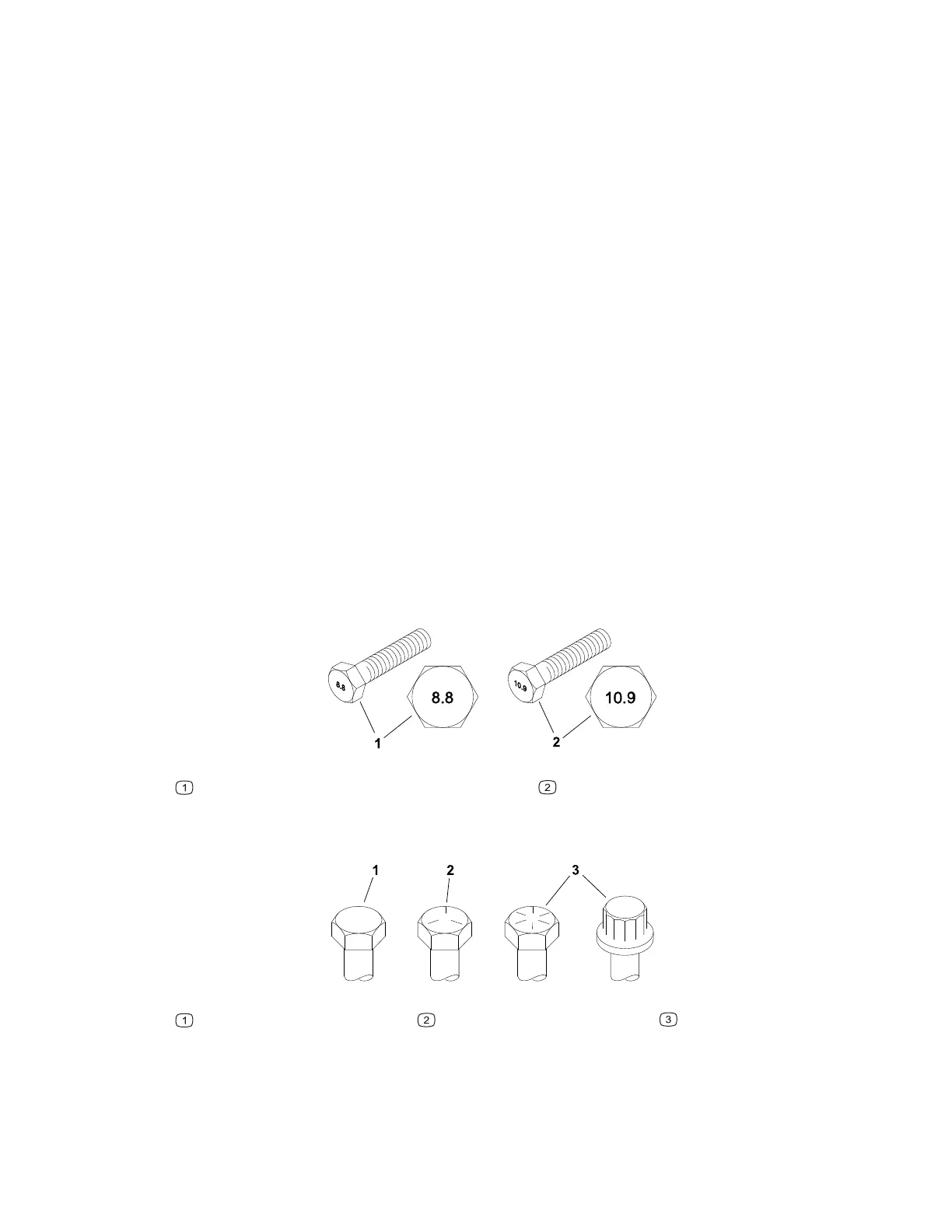
Fastener Identification
Figure 4
Metric Bolts and Screws
G421599
Class 8.8
Class 10.9
Figure 5
Inch Series Bolts and Screws
G421598
Grade 1
Grade 5 Grade 8
Specifications: Torque Specifications Page 2–4 4520P
09.40003Rev 00



 To Next Page