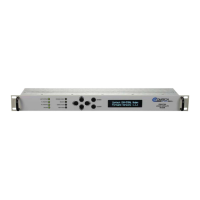
CDM-625A Advanced Satellite Modem MN-CDM625A
Front Panel Operation Revision 4
6–79
6.2.3 SELECT: Monitor Menu Branch
Monitor: Live-Alarms Stored-Events ACM
Stats Rx-Params RemEbNo AUPC CnC IP ()
Use the
◄ ►arrow keys to select a parameter. Press ENTER.
6.2.3.1 Monitor: Live-Alarms
Live Unit=None Net=None
Alarms Rx=Demod Lock Tx=No Clock ()
Live BUC=None
Alarms LNB=None ()
Six alarm types are available between two screens, as shown in the preceding examples. Use the
▲▼ arrow keys to navigate between these read-only pages. The highest priority alarm
currently active for each of the alarm types is as follows:
Alarm Type Description
PSU
Power supplies (+5V, +12V, -5V, +18V, -12V) are always monitored by
an onboard supervisory IC.
Tx and Rx Synth The PLLs in the IF sections are monitored for an unlocked condition.
Power Cal
Calibration data stored in EEPROM is checked at power-up to verify
that the factory calibration has not been corrupted.
FPGA Downloads are verified to have been loaded successfully.
No PLL Lock – This will suppress the Tx carrier.
(Transmit) No Clock
Clock activity from the Tx terrestrial source is checked if expected. The
modem falls back to the internal SCT clock to drive the modulator if
clock activity is absent.
FIFO Slip
Alarm occurs when the terrestrial clock source differs from the
programmed data rate, or may indicate a hardware failure.
Tx AIS
Alarm Indication Signal (all 1’s) is monitored at the Tx terrestrial input if
present.
AUPC Level
A Tx alarm occurs if the power increase limit has been reached when
AUPC is enabled.
Hi-Stab Freq Ref
Activity Fault
Reference not present; unit falls back to its internal 10MHz.
BUC summary alarm May occur only if ABA is enabled.
G.703 Loss of Signal May only occur in Clock Extension Mode.
PMSI Sym Clock Fail
In a CnC system where a 1:1 or 1:N redundancy switch is in use, this
alarm indicates that the PMSI symbol clock is not being detected in the
offline unit, suggesting a possible cable fault.


 To Next Page