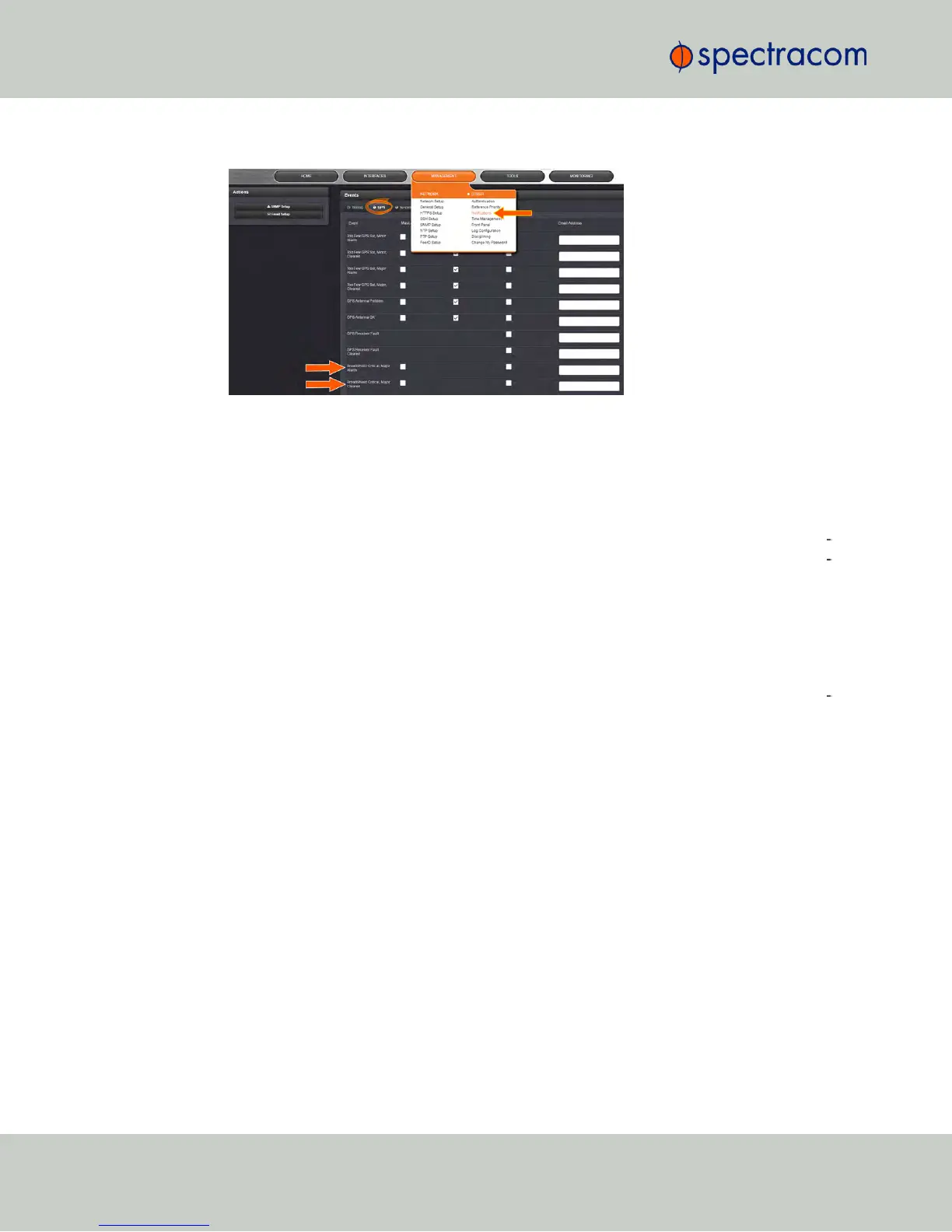
fications, see "Notifications" on page227.
3.3.3 The GNSS Reference
With most applications, NetClock will be setup such that it utilizes a GNSS signal as the
primary (if not the only) timing reference, because the time derived from a GNSS signal is
likely to be by far the most accurate time reference available. GNSS satellites (GNSS = Global
Navigation Satellite System e.g., GPS, GLONASS, Beidou, Galileo, QZSS) transmit a time sig
nal as part of their data stream, because a very precise time is required to accurately determ
ine your position on earth.
NetClock's GNSS receiver utilizes the signal provided by the GNSS antenna.
The GNSS receiver analyzes the incoming GNSS data stream and supplies the GNSS time and
1PPS (Pulse-Per-Second) signal to NetClock's timing system. The timing system uses the data to
control the System Time and discipline the oscillator.
While NetClock’s default GNSS receiver configuration will likely be adequate for most install
ations, it is advisable that you familiarize yourself with the basic configuration features so as to
achieve the best possible results. This is particularly true if you have poor GNSS reception.
182
CHAPTER 3 • NetClock User Reference Guide Rev. 16
3.3 Managing Input References



 To Next Page