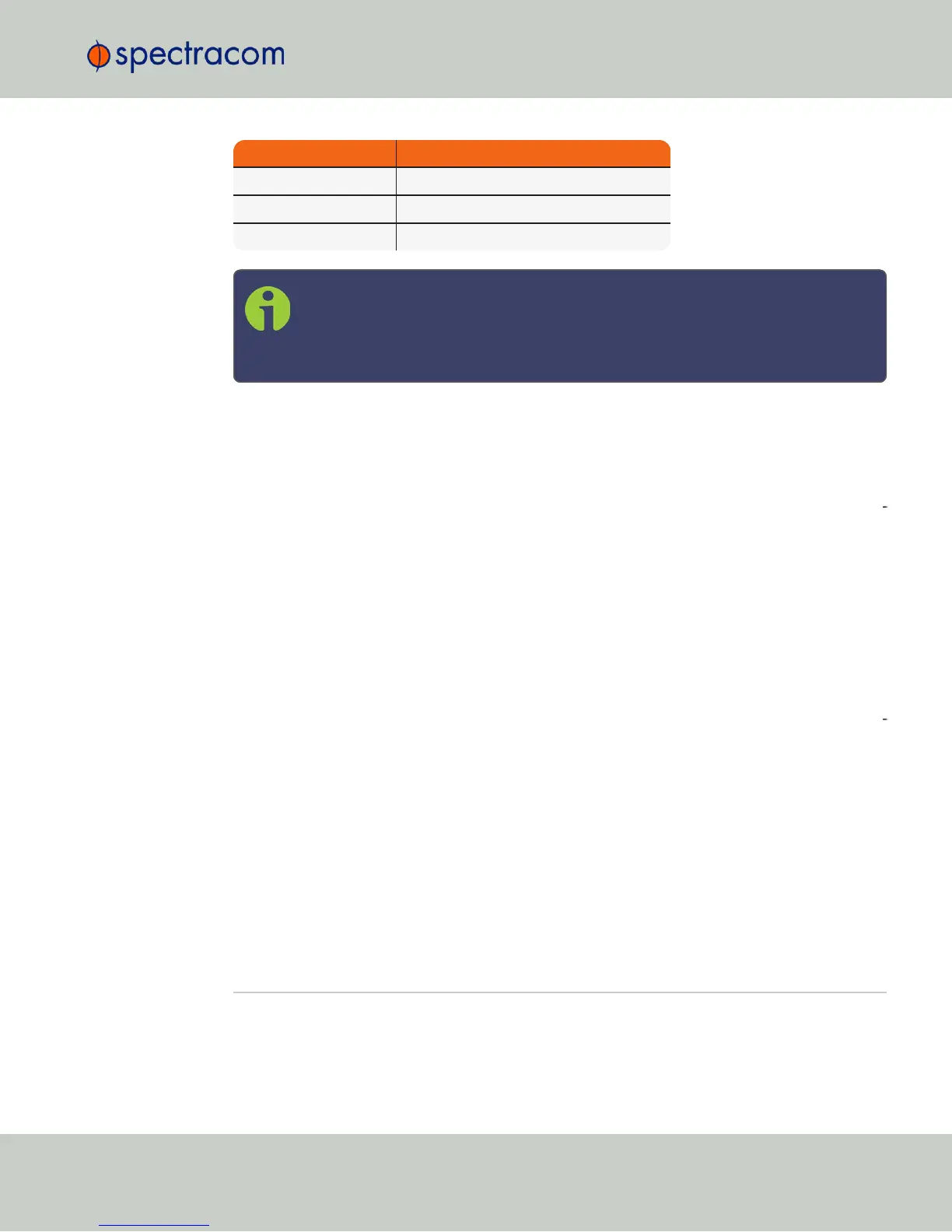
Desired Holdover Length Holdover Length (in seconds) to be entered
7 days 604 800
30 days 2 419 200
1 year 29 030 400
Note: Due to Leap Seconds that are periodically inserted into the UTC and Local
timescales, it is not normally recommended to exceed 30 days of Holdover
without an external reference that can supply Leap Second information being
applied (such as GNSS).
Configuring a Holdover value exceeding 30 days could result in a one second time error in
the UTC or Local timescales until an external reference (GNSS or IRIG input) is restored or a
manually configured Leap Second is asserted by a user (leap seconds do not affect the GPS
and TAI time scales).
If no external references (such as GNSS or IRIG) are available when a Leap Second is sched
uled to occur, manual Leap Seconds can also be applied to the UTC or Local time base; see
"Leap Seconds" on page155.
If the Holdover Timeout has expired, do I need to reset the clock once GPS
becomes available again?
No, the Holdover timer is automatically reset as soon as at least one reference has been
restored/returned for at least one second. If GPS is restored and then lost again moments later,
the Holdover timer starts again with its full value. If its set to one week in this case, it then gets
another week of Holdover operation before NTP goes to Stratum 16 (if GPS remained unavail
able for the entire week).
Holdover mode and the User/User reference
If the only available input reference is a manually set User time, and NetClock is subsequently
rebooted or power cycled, time sync will be lost when NetClock powers back-up. The time will
need to be set manually again in order for NetClock to return to its fully synchronized state.
See "The "User/User" Reference" on page167 and "Manually Setting the Time" on page150
for more information.
3.5 Managing the Oscillator
The purpose of the built-in oscillator is to provide NetClock with an accurate and very stable
internal frequency source. This allows NetClock to go into a holdover mode in the event that
external time or frequency references are lost or become invalid. However, the oscillator can
3.5 Managing the Oscillator
CHAPTER 3 • NetClock User Reference Guide Rev. 16
213



 To Next Page