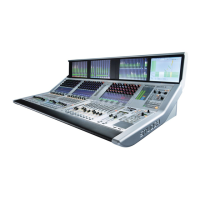
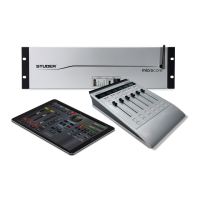
Vista 1 Digital Mixing System
GC Operation 4-71
Document generated: 18.04.17
SW V5.3
4.4.5.3 Theatre Workflow Tutorial
In general, a cue-based production usually has a workflow similar to the fol-
lowing scenario:
1. Console Setup The channels are labeled, patch connections are made, etc.
2. Building Cues With the help of the script, the cues are created and named.
VCAs are labeled and channels are assigned to VCAs.
Mutes are made (per cue).
3. Rehearsal Phase This is the first time that the cast is involved. No orchestra yet, just a piano.
Mic gains and EQs are set, but only in a hurry, since rehearsals go fast
(through all cues).
With more rehearsals, the mic gain and EQ settings get refined.
Cues need to be added.
4. Dress Rehearsal Phase This is the first time that the orchestra/band is involved. These channels can
now be setup (gain, EQ, monitor mix).
Now with dresses, props and orchestra, vocals sound different; mic gains and
EQs need to be refined.
5. Preview Rehearsal Phase This is the first time that an audience is involved. Things sound different again
since the audience modifies the acoustics of the venue.
Fader levels, gains and EQs need to be adapted.
6. Shows During the show, the console operator reads the script, goes from cue to cue
and rides VCA master levels. Usually there is no time available for changing
parameters apart from the VCA levels.
Basically, the channel settings don’t change anymore, but it may happen
anyway (almost every show) that an actor or a musician of the orchestra needs
to be replaced due to sickness or other reasons.
This means that channel settings such as mic gain, EQ and dynamics need
to be adapted to the current understudy actor; this is, however, only required
for the corresponding input channels.
Glossary: Character / Role The name or term of the character or role in the script, such as Romeo, Julia,
etc. It is very important to understand that one input channel of the console
should always be fed with the mic signal of one certain character/role through-
out the whole play.
Actor Name of the person who is playing a specific character/role.
Understudy Actor who replaces the main actor in case of sickness, different shifts, etc.
Cast The ensemble/company, i.e. all (or several) actors or all actors of a play.
Conventions for the Workflow Suggested Below:
• Aninputchanneloftheconsoleisequaltoacharacteroftheplay.
E.g.Inpm1=Romeo;Inpm2=Julia,etc.
• WhentheroleofRomeoisplayedbyanactorcalledJohnSmith,anactor
for Romeo’s role (Inp m1) needs to be created whose name is John Smith.
• Lateron,anunderstudyactorcanbecreatedasacopyofJohnSmithbut
with the actual understudy’s name.


 To Next Page