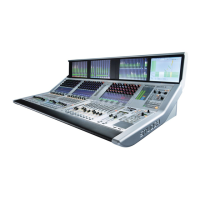
Vista 1 Digital Mixing System
1-18 Introduction
Document generated: 18.04.17
SW V5.3
1.3 Channels, Routing and Busses
D21m
Option Slots
USB
Jingle Player
Input Stereo
1...n
Input 5.1
6
1...n
AUX Mono
1...n
AUX Stereo
1...n
GRP Mono
1...n
GRP Stereo
1...n
GRP 5.1
1...n
Master Mono
1...n
Master Stereo
1...n
Master 5.1
1...n
DSP Router
Input Channels Output Channels
Direct Out
AF
PF
INP
Gain
HP/LP
Phase
EQ DYN DLY
Fader
Mute
PAN
CH Switching Matrix
Configurable Processing
L/R or
Surround
Master, Group,
PFL, SOLO,
MCH, N–1
Input Mono 1...n
Buses
INS
16-Ch Input
Modules
D21m
Option Slots
16-Ch Output
Modules
Input Ports Output Ports
Processing blocks, such as equalizer, dynamics, delay, etc., can be configured
for all channel types.
Input Channels Vista’s digital routing matrix is located between the console’s physical inputs
and the actual DSP channels. This topology means that the physical analog
and digital inputs can be assigned to any console channel via the General
Patch page on the Graphical Controller. The patch setup forms part of each
individual snapshot, and can be saved, updated and recalled within the Snap-
shot/Preset system.
Output Channels This also applies to the outputs. On the General Patch page, each channel’s
output can be selected and sent to any analog or digital output destination.
Auxiliary Busses (AUX) The number of stereo or mono AUX sends is pre-defined by the configuration
currently loaded – four configurations are shipped with the console to select
from. The AUX master channels are equipped with a selection of processing
blocks such as equalizer, dynamics, delay, and more (or less).
Clean-Feeds/Mix-Minus (N–X) Mono or stereo clean-feeds/mix-minus busses (also referred to as ‘N–X’) are
also part of the configuration currently loaded.
Multi-track and Group Routing Multi-track and group routing is part of the currently selected configuration,
as already mentioned above.
Solo Modes Each channel features a Solo and a PFL Switch. Depending upon the mode
selected within the control bay the SOLO key is active as SOLO or Solo-In-
Place. Clearing these buttons can be achieved by opening the corresponding
fader in case ‘PFL BC’ (Broadcast) is active. A very handy PFL/Solo Reset
is provided to disengage any solos regardless of where they are engaged on
the console. This eliminates the need to ‘search’ for solos with large console
configurations. A key to define certain channels to be safe from being muted
in ‘Solo-In-Place’ mode is also provided. This set will be stored with each
title.


 To Next Page