8 DTrack2 frontend software
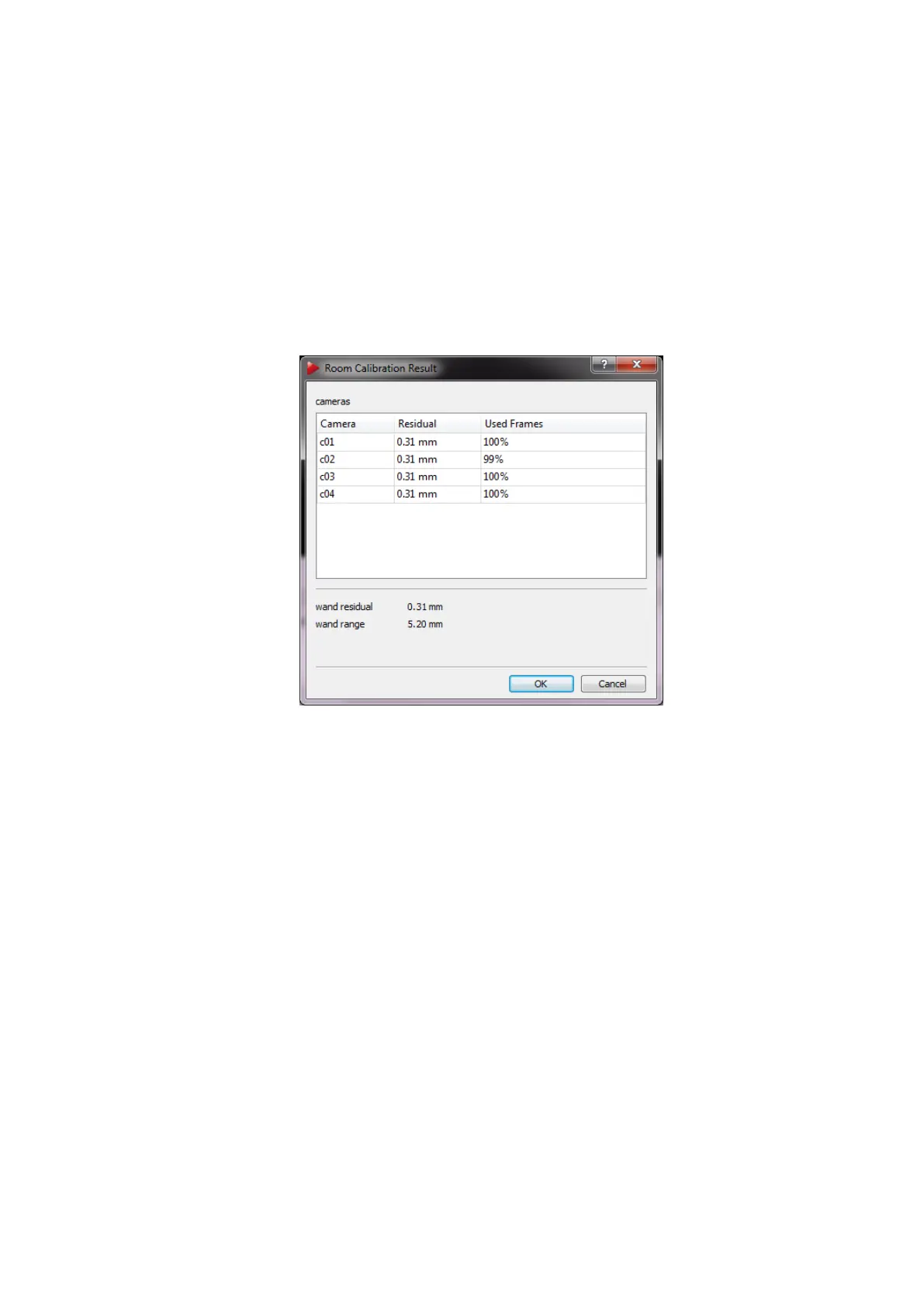
(’wand residual’) and the maximum deviation (’wand range’) of wand length during the
calibration process. The value ’Used Frames’ represents the percentage of valid (i.e.,
used for room calibration) data for each camera.
Try to achieve a low ’mean wand residual’ up to 1 mm for VR installations while having
high values for ’Used Frames’. The number of ’Used Frames’ should be greater than 70%
for each camera. Values under 50% indicate poor room calibration quality. The param-
eters ’Residual’ for each camera and the ’wand range’ depend on the system geometry
and give additional information about the quality of calibration. Please call ART for further
information.
Figure 8.25: Room calibration result
The room calibration is confirmed (i.e., the data are stored) by pressing the button OK .
Z
Please note that percentages of more than 70% may not be reached in
large and complicated measurement volumes.
8.6.3.3 Room re-calibration
All camera setups may change after a certain operation time; if e.g. movement of single
cameras due to mechanical instabilities cannot be ruled out or thermal drifts occur it is
necessary to perform room calibrations periodically. DTrack2 provides a simplified room
calibration to revise an existing room calibration without need of an calibration angle,
called room re-calibration.
This means no calibration angle has to be present in the measurement volume; only
the wand has to be moved the same way as for a standard room calibration. The main
advantage of a room re-calibration is that DTrack2 preserves the origin of your coordinate
system and therefore, the orientation of the coordinate system as well.
170


 To Next Page