Chapter 4
4.4 ARTTRACK2 (discontinued)
If in doubt, ask a skilled craftsman for assistance. Use massive and long enough angle
irons to provide the required stiffness and stability.
To avoid measurement problems, no light sources or highly reflecting areas should be
visible to the camera. Especially strong point light sources like e.g. halogen lamps and
direct or reflected sunlight may imply problems for the measurement (fluorescent lamps
are ok).
Please install the cables such that
• no one can stumble over the cords,
• the cords cannot be damaged,
• the cords cannot damage the cameras due to mechanical strain,
• the line of sight of the cameras is not obstructed.
Inappropriate cabling may pose a serious hazard to health and safety.
Cable ducts or fixings should be used and a strain relief should be
installed!
Please refer to chapter 5.2 on page 60 for more information.
4.4 ARTTRACK2 (discontinued)
Keep a distance of min. 20 cm when operating the camera ! The
camera is assigned to the Exempt Group according to IEC62471-1 and
therefore poses no risk or hazard to the human eye or skin at this dis-
tance.
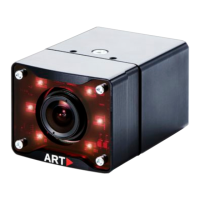
Description The ARTTRACK2 infrared camera is intended for working environments
with distances between camera and markers of up to 4 metres. By default the ART-
TRACK2 is equipped with a 3.5 mm lens. Depending on the application and the setup the
ARTTRACK2 can be equipped with other lenses (i.e. with different focal lengths). Refer
to A.1 on page 236 for a list of available focal lengths and the respective FoV.
Mounting The ARTTRACK2 cameras are optimized for a predefined range of measure-
ment volumes. System operation in smaller or bigger measurement volumes can lead to
reduced accuracy. The measurement volume can be adjusted within certain limits simply
by changing the flash intensity of the ART infrared cameras (see chapter 8.5.1 on page
146).
i
The flash intensities should not be too high. In general, a flash inten-
sity of 3-4 might be sufficient.
37


 To Next Page