4 ART Tracking Cameras
Please install the cables such that
• no one can stumble over the cords,
• the cords cannot be damaged,
• the cords cannot damage the cameras due to mechanical strain,
• the line of sight of the cameras is not obstructed.
Inappropriate cabling may pose a serious hazard to health and safety.
Cable ducts or fixings should be used and a strain relief should be
installed!
Please refer to chapter 5.2 on page 60 for more information.
4.2 ARTTRACK5/C
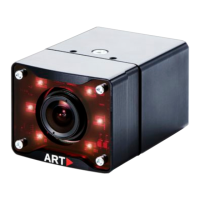
Keep a distance of min. 20 cm when operating the camera ! The
camera is assigned to the Exempt Group according to IEC62471-1 and
therefore poses no risk or hazard to the human eye or skin at this dis-
tance.
Description The ARTTRACK5 or TRACKPACK/E system may be combined with the
ARTTRACK5/C camera in order to realize tracking in multi-sided projection environments
(e.g. CAVE
R
, I-Space). In such an environment it is necessary to drill holes into the pro-
jections’ corners as the camera cannot see through the screen. The ARTTRACK5/C cam-
era has been designed to easily fit into such holes by separating the lens from the elec-
tronics part (see figure 4.4). With its 4.0 mm lens a large field of view (FoV) is covered.
Refer to A.1 on page 236 for more information.
The 26-pin D-Sub connector between ARTTRACK5/C remote camera
head and camera body employs proprietary design. Do not try to con-
nect the remote head to any other port (e.g. COM port) !!!
The ARTTRACK5/C system either consists of ARTTRACK5/C cameras only or it can be
mixed with standard ARTTRACK5 or TRACKPACK/E cameras - both variants are limited
to a total number of 50 cameras per system.
Mounting The ARTTRACK5/C cameras are optimized for a predefined range of mea-
surement volumes. System operation in smaller or bigger measurement volumes can
lead to reduced accuracy. The measurement volume can be adjusted within certain limits
simply by changing the flash intensity of the ART infrared cameras (see chapter 8.5.1 on
page 146).
i
The flash intensities should not be too high. In general, a flash inten-
sity of 50-60 might be sufficient.
32


 To Next Page