4 ART Tracking Cameras
4.8 Setting up the cameras
4.8.1 Camera orientation
After mounting and connecting the cameras to the controller, the next step is to adjust the
orientation of each camera such that the measurement volume is covered completely by
the field of view (FoV) of all cameras. On the one hand camera mounting has to ensure
that tracking is possible over the entire measurement volume. On the other hand atten-
tion has to be paid to the fact that the calibration angle (for room calibration) can be seen
completely by at least two cameras. Moreover, the FoV of all cameras has to overlap
sufficiently to enable the calculation of the photogrammetric orientation of all cameras in
a common coordinate system, especially if the calibration angle can not be seen by each
camera.
Additionally this step is important for removing disturbing reflections (refer to 4.8.2 on
page 48) as well as ruling out mutual blinding of the cameras, i.e. the IR flash of one
camera is inside the FoV of another(refer to 4.8.2.1 on page 49). Therefore, as part of
its GUI DTrack2 provides the Monitor 2DOF display which is essentially a 2-dimensional
graphical display of all markers / flashes or other IR sources that can be seen inside the
FoV of the cameras. At this point, you will probably find it most useful to become ac-
quainted with the graphical user interface and the main window of DTrack2 . Please refer
to chapter 8.3 on page 132.
4.8.2 Localizing and removing of disturbing reflections
Possible sources of disturbing reflections may be diverse. Still all of them may be detected
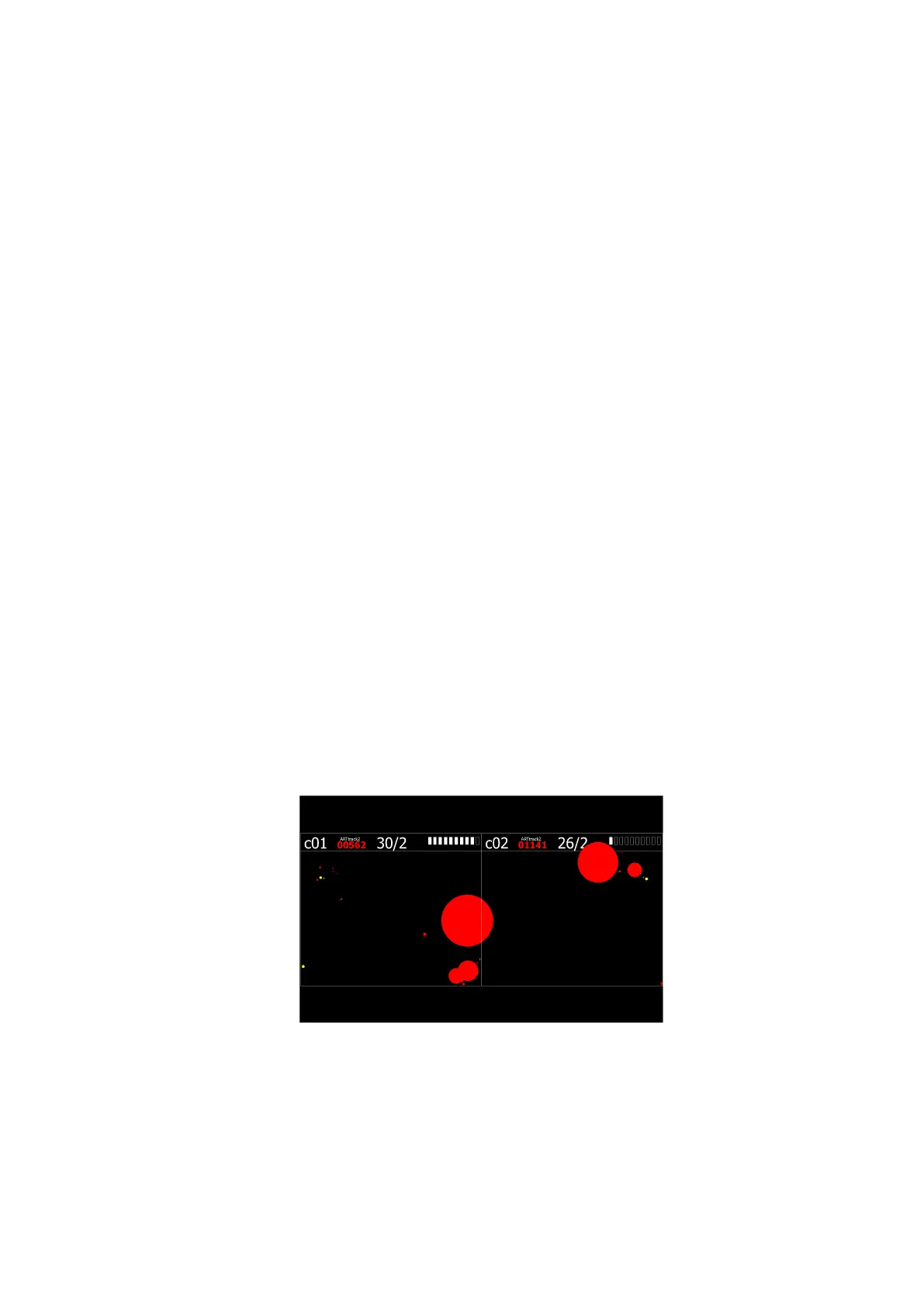
when starting the Monitor 2DOF display in DTrack2 . They are illustrated the same way
as markers, i.e. with small coloured crosses or circles, depending on the distance to the
camera (see figure 4.12 on page 48).
Figure 4.12: Typical situation arising from reflections through sunlight
Typically the reflections arise from one (or more) of the following points:
• active or passive targets that are inside the FoV / tracking range of the cameras,
48


 To Next Page