2 Introduction
Marker types Passive markers are covered with retro reflective material - they act as
light reflectors. Active light emitters (i.e. based on infrared LEDs) are called active mark-
ers (see chapter 3 on page 20).
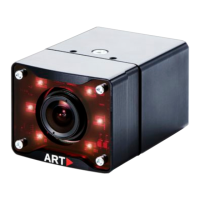
Tracking in detail The cameras send out synchronized IR flashes which are reflected
back into the lens by retro-reflective material covering the markers of the target. The
tracking cameras scan a certain volume, detect the IR radiation that is reflected by the
markers and create a greyscale image based on the received IR radiation. During prepro-
cessing the intelligent cameras calculate the 2DOF marker positions with high accuracy
using pattern recognition algorithms.
Then the 2DOF data are being sent to a controller via ethernet which calculates 3DOF
or 6DOF information. The base for this calculation is that the cameras’ field of views
are overlapping. DTrack2 calculates the path of the optical rays from the cameras to the
markers and delivers the ray intersections in three-dimensional coordinates. These inter-
sections are the positions of the markers.
The position and orientation of the cameras is made known to the system during ’room
calibration’, while during ’body calibration’ DTrack2 identifies the unique arrangements of
markers as targets. Based upon these two teaching steps, DTrack2 is able to calculate
6DOF data and, finally, knows position and orientation of the target and therefore of the
object or individual to be tracked.
Note: In pure optical tracking systems tracking is only possible as long as
• objects or individuals to be tracked are equipped with single markers or targets
• the target is not occluded by any other objects in the cameras’ line of sight, which
could even be the object itself
• the target is positioned inside the tracking range of the cameras
• at least four markers of a target are visible to at least two cameras (in more detail:
to enable tracking).
Hybrid tracking In addition to tracking by a pure optical system it is possible to uti-
lize data from inertial measurement units (IMU). These devices usually consist of several
components such as gyroscopes, accelerometers and magnetometers. The underlying
principle is the combination of solid-state microelectromechanical systems with integrated
circuits and analog or digital outputs to achieve 6DOF rotational information.
Some of the most important advantages of hybrid tracking are:
• tracking data from IMUs offers low noise-levels while running at very high frequen-
cies in combination with low latencies
• IMUs deliver tracking data (i.e. rotational information) even when the optical target
is not inside the tracking volume or if the target cannot be tracked due to viewing
limitations or occlusions
18


 To Next Page