Uni-Probe LB 490
BERTHOLD TECHNOLOGIES GmbH & Co. KG
2 – 157
Volume 2 2 Installation
2
Please observe the alignment of the radiation window, see dimen-
sional drawing of the detector (page 2–251).
The detector is installed using a fixture (see also page 2–252) that
is provided by the customer. The distance to the surface of the ves-
sel or the surface of a thermal insulation should be about 100mm.
Clamps or an installation kit are used for installation on a suitable
bracket or a rail such that the radiation window facing the source is
not covered, see sections 6.1.1 to 6.1.3 on page 2–252. The radia-
tion window is facing the source.
2.4.4 Super-Sens
Function failure due to damaged detector
The detector fixture must not transfer any vibrations or heat onto
the detector; otherwise the detector will be disturbed or may fail
altogether.
Therefore, install the fixture on a vibration-free support or attenu-
ate possible vibrations using vibration absorbers. Make sure to pre-
vent heat transfer to the detector via the detector fixture by using
suitable insulating materials.
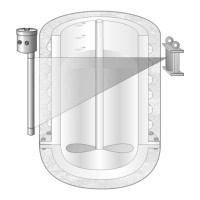
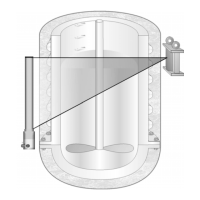
The applications described above can also be used in combination
with the Super-Sens, for example, to irradiate thicker vessel walls,
without having to increase the source activity. The Super-Sens sup-
ports a version with frontal irradiation (Figure 2-13 and Figure
2-14) and also with radial irradiation (Figure 2-15).
The detector is installed using a fixture (see also page 2–264)
which is provided by the customer. The distance to the surface of
the vessel or the surface of a thermal insulation should be about
100 mm. It is installed onto a suitable bracket using clamps or a
rail, such that the radiation window facing the source is not cov-
ered. The radiation window of the Super-Sens detector has to be
aligned toward the source.
For more information on the fixtures please see the technical draw-
ings in section 6.3.7 on page 2–267.


 To Next Page
 Loading...