118 | Chapter 3: Operation
Timer-activated: use this option to control the start time of a protocol step. This
option is most useful in complex protocols that use the BioStack or another robot to
process multiple plates. You can make sure that each plate is processed at a precise
time.
Delay Behavior
Sound alert at start of delay: de-select this option to silently display the message
box at the start of the delay. The audio volume is controlled under
Instrument>Preferences. It chimes one time only at the start of the delay
concurrent with an opening message.
Prompt: enter text, if desired, to display in a message box that opens during
runtime at the start of the delay.
Timer Activated Delay
To gain precise control over your chemistry in complex protocols, consider using
the Timer Activated delay option to specify when to launch a protocol step. You
can make sure processing time is the same for every plate, to ensure, for example,
that reagent remains in every plate for a minimum or uniform time period.
This is especially beneficial when designing a multi-step BioStack protocol that is
run with varying numbers of plates in the stack. If the timer is not used in this
scenario, assay performance could be significantly different in a run of 30 plates
versus a 10-plate run.
n Important: if the timer activated interval elapses before the steps in the step
container are completed, there will be no delay, i.e. all steps will be executed
without timed control.
A Timer-Activated Delay puts start and end steps in the protocol, similar to the
BioStack loop. To remove the delay from the protocol, you must delete both steps.
Examples:
n These examples show protocols for an EL406 Washer Dispenser, but the same
principles apply to the MultiFlo FX.
Simple Delay
To use the timer successfully, you must first determine the approximate duration
of your protocol steps. Specify a sufficient time lapse to both complete the steps
and to delay the process to suit your assay.
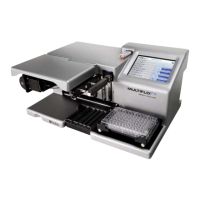
MultiFlo™ FX Multi-Mode Dispenser


 To Next Page