CDM-625A Advanced Satellite Modem MN-CDM625A
Appendix B Revision 4
B–12
B.7.3 End-to-End Processing Delay
In many cases, FEC methods that provide increased coding gain do so at the expense of
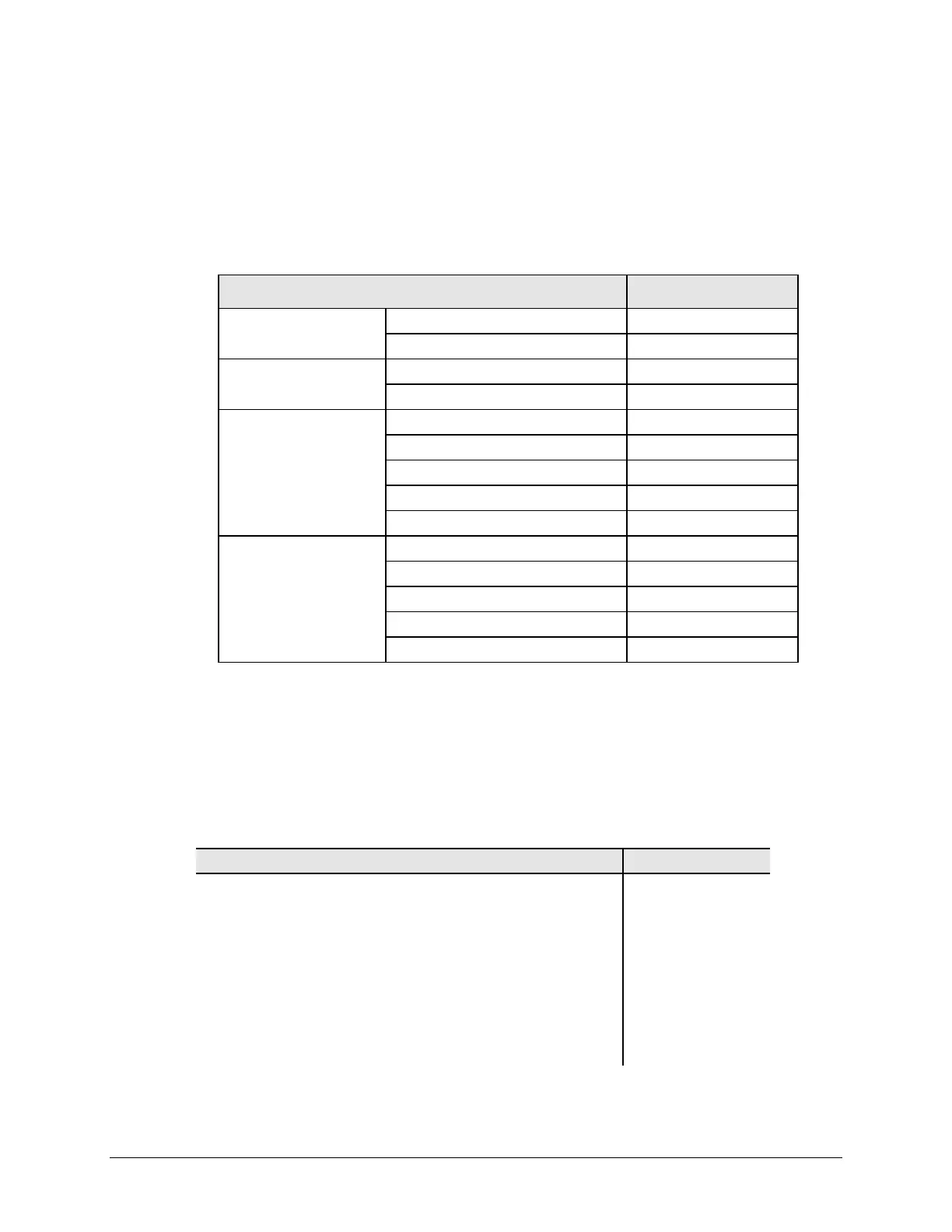
increased processing delay. However, with TPC, this increase in delay is very modest. Table B-7
shows the processing delays for the CDM-625A’s major FEC types, including the three TPC
modes.
Table B-7. TPC/LDPC Processing Delay Comparison
FEC Mode (64 kbps data rate) End-to-end delay (ms)
Viterbi
9
266
Sequential
Rate 1/2
74
522
Turbo Product Coding
47
41
Rate 5/16
69
245 *
69
LDPC Coding
Rate 1/2 198
Rate 2/3, O/QPSK 234
Rate 2/3, 8-PSK, 8-QAM 350
Rate 3/4, O/QPSK 248
Rate 3/4, 8-PSK, 8-QAM, 16-QAM 395
*A larger block is used for the Rate 7/8 code, which increases decoding delay.
Note that, in all cases, the delay is inversely proportional to data rate, so for 128 kbps, the delay
values would be half of those shown above. It can be seen that the concatenated Reed-Solomon
cases increase the delay significantly (due mainly to interleaving/de-interleaving), while the TPC
cases yield delays which are less than or equal to Sequential.
Table B-8. TPC/LDPC Summary
• Exceptionally good BER performance – significant improvement
compared with every other FEC method in use today.
Nothing!
• Most modes have no pronounced threshold effect – fails
•
Exceptional bandwidth efficiency.
•
Coding gain independent of data rate (in this implementation).
• Low decoding delay for TPC.
• Easy field upgrade in CDM-625A.


 To Next Page