
 Need help?
Do you have a question about the HP 262SA and is the answer not in the manual?
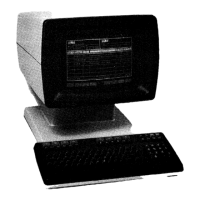
The HP 2625A Dual System Display Terminal and the HP 2628A Word Processing Center are versatile display terminals offering a range of functionalities. The 2625A provides dual personality, operating as an HP terminal (similar to the HP 2622A) or simulating an IBM 3276 Control Unit/Display Station. The 2628A, on the other hand, is primarily a word processing terminal with HPWORD capability, which is also an option for the 2625A.
These terminals are designed for data display, entry, and processing, with capabilities for both local and remote operations. They feature a display memory that stores data for screen display, partitioned into an HP workspace and, for the 2625A, an IBM workspace. The portion of the workspace currently visible on the screen is called the "window."
Terminal Modes: The terminals operate in various modes:
User-Definable Function Keys: Eight programmable function keys can be defined locally or remotely. Each key has an operational attribute (Local, Transmit, or Normal), an alphanumeric label (up to 16 characters with video enhancement options), and a definition string (up to 80 characters including escape sequences and control codes).
Keyboard Data Entry and Controls: Data can be sent to the computer via the ENTER key or escape sequences. The keyboard can be enabled/disabled programmatically. Soft and hard resets are available to clear error conditions, reset modes, or restore default configurations.
Graphics (Option 523): Both terminals can incorporate graphics capabilities, allowing display of graphics data on a 512x390 array. Graphics and alphanumeric data share the screen but are stored in separate RAM memories. Graphics functions include cursor control, display memory control, drawing modes (set, clear, complement, jam), line types (solid, user-defined, predefined patterns, point plot), area fills (rectangular, polygonal, predefined patterns, user-defined patterns), and graphics text with various sizes, orientations, and slants.
Word Processing (HPWORD, Option 528 for 2625A, Standard for 2628A): Provides text entry and editing functionalities.
Configuration: The terminal's configuration is managed through on-screen menus (Global, Terminal, and Datacomm Configuration menus) or programmatically via escape sequences. Settings stored in nonvolatile memory become active at power-on.
Cursor Controls: Comprehensive cursor movement functions are available, including Home Up, Home Down, Move Cursor Up/Down/Right/Left, and Screen/Workspace Addressing (absolute and cursor-relative).
Window Control: The display window can be positioned in the workspace to show selected 24-row "pages" of data. "Roll" functions allow scrolling text up or down one row at a time, while "Page" functions move the display by 24 lines.
Edit Operations: Standard editing functions include Insert Line, Delete Line, Insert Character (with or without wraparound), Delete Character (with or without wraparound), Clear Display, and Clear Line.
Margins and Tabs: Left and right margins can be redefined, affecting cursor positioning and insert/delete operations. Tab stops can be set and cleared, with the left margin always acting as an implicit tab stop.
Peripheral Device Connection: Printers and plotters can be connected via an Alternate Peripheral Interface network (options 026, 046). The terminal supports various HP plotters and external printers.
Data Transfer:
Data Logging: "Log Top Mode" prints lines purged from the top of the display, while "Log Bottom Mode" prints lines as the cursor moves to a new line, maintaining a hard copy "trail."
IBM Emulation (HP 2625A): The 2625A can emulate an IBM 3276 Control Unit/3278 Display Station, connecting to IBM host computers via remote bisynchronous connections. It supports screen sizes of 1920, 2560, and 3440 characters, appearing as a model 2, 3, or 4 of the 3276. IBM keyboard functions are mapped to HP keys, with specific differences in implementation.
Troubleshooting: Procedures include checking configuration settings, performing soft or hard resets, and running a terminal self-test.
Soft Reset: Rings the bell, halts device operations, enables the keyboard, clears error messages, disables Display Functions mode, halts datacomm transfers, and resets the integral printer. Screen data and active modes (except Display Functions) remain unchanged.
Hard Reset: Rings the bell, halts device operations, enables the keyboard, clears all workspace data, clears error messages, disables Display Functions/Caps Lock/Report/Metric/data logging modes, resets margins/tabs, turns off insert character, and resets the integral printer and graphics memory. All configuration parameters revert to power-on values, and user-programmable function keys return to default settings.
Preventive Maintenance:
Display Adjustments: Brightness and focus knobs are located on the rear panel for optimizing screen image clarity. The screen image can also be centered using specific key combinations.
Printer Self Test: The integral printer has a self-test feature to verify proper functioning, displaying a test pattern if successful. Error messages related to the printer (e.g., out of paper, open printer gate) can be cleared.
Loading Printer Paper: Detailed instructions are provided for loading thermal paper, emphasizing correct orientation and avoiding the glue spot during print operations. Only HP Thermal Paper is recommended to maintain print head life and warranty validity.
 General
| Brand | HP |
|---|---|
| Model | 262SA |
| Category | Touch terminals |
| Language | English |



 To Next Page