Data Communications
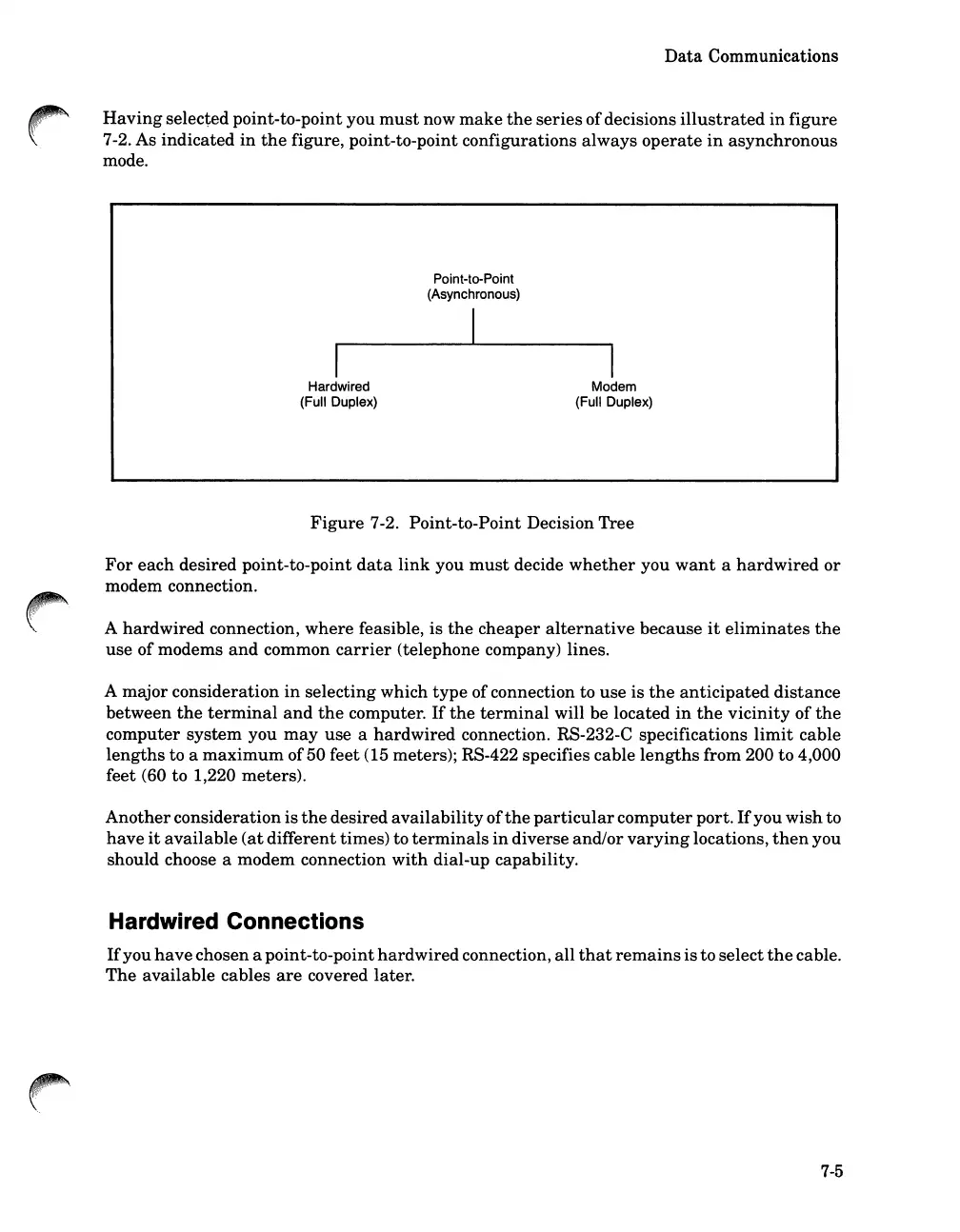
Having
selected point-to-point you
must
now
make
the
series
ofdecisions
illustrated
in
figure
7-2. As
indicated
in
the
figure, point-to-point configurations
always
operate
in
asynchronous
mode.
Point-to-Point
(Asynchronous)
Hardwired
(Full Duplex)
Modem
(Full Duplex)
Figure
7-2. Point-to-Point Decision Tree
For
each
desired point-to-point
data
link
you
must
decide
whether
you
want
a
hardwired
or
modem connection.
A
hardwired
connection,
where
feasible,
is
the
cheaper
alternative
because
it
eliminates
the
use
of
modems
and
common
carrier
(telephone company) lines.
A
major
consideration
in
selecting which
type
ofconnection to use is
the
anticipated
distance
between
the
terminal
and
the
computer.
If
the
terminal
will be located
in
the
vicinity
of
the
computer
system
you
may
use
a
hardwired
connection. RS-232-C specifications
limit
cable
lengths
to a
maximum
of
50 feet (15 meters); RS-422 specifies cable
lengths
from 200 to 4,000
feet (60 to 1,220 meters).
Another
consideration
is
the
desired
availability
of
the
particular
computer
port.
If
you
wish
to
have
it
available
(at
different
times) to
terminals
in
diverse and/or
varying
locations,
then
you
should choose a modem connection
with
dial-up capability.
Hardwired Connections
If
you
have
chosen a point-to-point
hardwired
connection, all
that
remains
isto select
the
cable.
The
available
cables
are
covered later.
7-5











 To Next Page