EasyManua.ls Logo

HP 262SA - To Return to Normal Operation; Global Configuration

HP 262SA
390 pages
Print Icon
To Next Page IconTo Next Page
To Previous Page IconTo Previous Page
Loading...
Configuring
the
Terminal
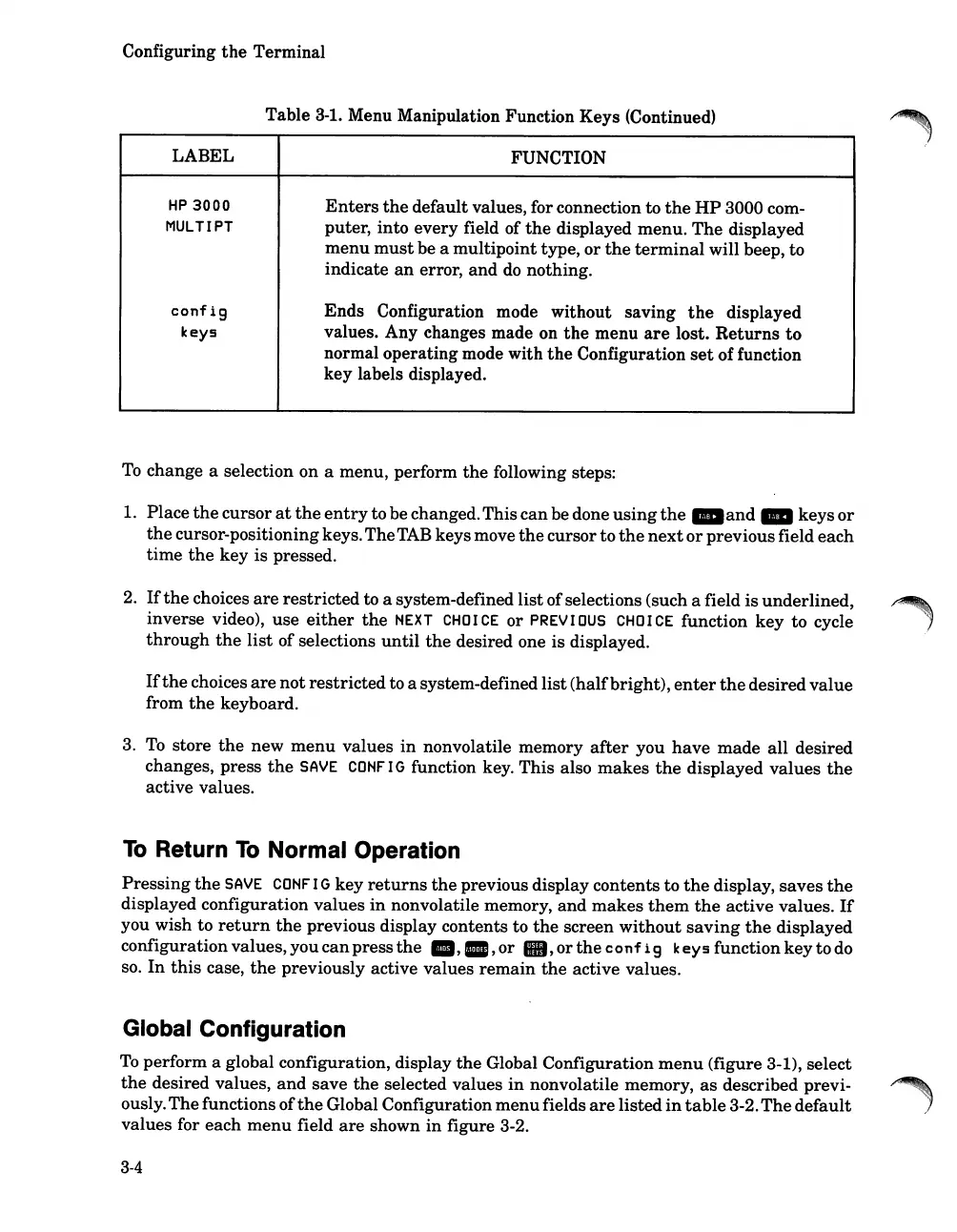
Table
3-1. Menu Manipulation Function
Keys
(Continued)
LABEL
FUNCTION
HP
3000
Enters
the
default
values, for connection
to
the
HP
3000 com-
MULTIPT
puter,
into
every
field
of
the
displayed
menu.
The
displayed
menu
must
be a
multipoint
type,
or
the
terminal
will beep, to
indicate
an
error,
and
do
nothing.
canfig
Ends
Configuration mode
without
saving
the
displayed
keys
values.
Any
changes
made
on
the
menu
are
lost.
Returns
to
normal
operating
mode
with
the
Configuration
set
of
function
key
labels displayed.
To
change
a selection
on
a
menu,
perform
the
following steps:
1. Place
the
cursor
at
the
entry
to be changed.
This
can
be done
using
the
.and
_
keys
or
the
cursor-positioningkeys.
The
TAB
keys move
the
cursor
to
the
next
or
previous
field
each
time
the
key
is
pressed.
2.
If
the
choices
are
restricted
to a system-defined
list
of
selections (such a field
is
underlined,
inverse
video),
use
either
the
NEXT CHOI
CE
or
PREVIOUS
CHOI
CE
function
key
to
cycle
through
the
list
of
selections
until
the
desired one
is
displayed.
If
the
choices
are
not
restricted
to a system-defined
list
(half
bright)
,
enter
the
desired
value
from
the
keyboard.
3.
To
store
the
new
menu
values
in
nonvolatile
memory
after
you
have
made
all
desired
changes,
press
the
SAVE
CONF
I G function key.
This
also
makes
the
displayed
values
the
active values.
To
Return
To
Normal Operation
Pressing
the
SAVE
CONF
I G
key
returns
the
previous display
contents
to
the
display,
saves
the
displayed
configuration
values
in
nonvolatile memory,
and
makes
them
the
active
values.
If
you wish
to
return
the
previous
display
contents
to
the
screen
without
saving
the
displayed
configurationvalues,
you
can
press
the
.,
_,or
1lB,0rthe
canf
ig
keys
function
key
to
do
so.
In
this
case,
the
previously
active
values
remain
the
active values.
Global Configuration
To
perform
a global configuration, display
the
Global
Configuration
menu
(figure 3-1), select
the
desired
values,
and
save
the
selected values
in
nonvolatile memory,
as
described previ-
ously.
The
functions
of
the
Global Configuration
menu
fields
are
listed
in
table
3-2.
The
default
values
for
each
menu
field
are
shown
in
figure 3-2.
3-4

Table of Contents

Related product manuals