Designing and Using
Forms
ENABLING AND DISABLING FORMAT MODE
Forms
are
defined
with
Format
mode disabled,
but
are
not
interpreted
as
such
until
Format
mode is
initiated.
When
Format
mode
is
initiated,
all ofdisplay memory is
CCprotected"
except for those portions
which
have
been
explicitly defined
as
cCunprotected"
and
CCtransmit-only" fields.
The
FORMAT
MODE
function key
alternately
enables
and
disables
Format
mode.
When
Format
mode is enabled,
an
asterisk
appears
in
the
associated screen label.
The
following
keystroke
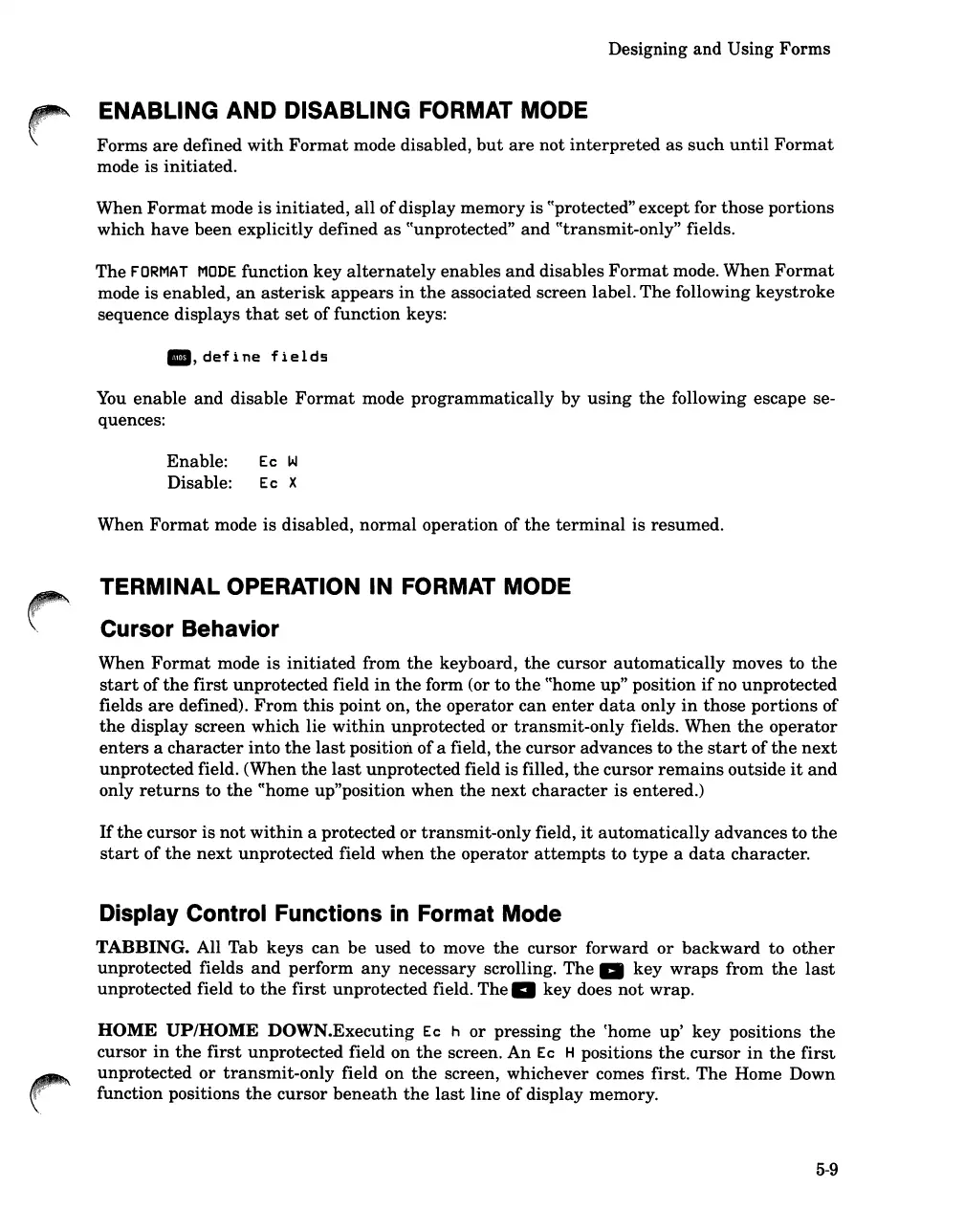
sequence displays
that
set
offunction keys:
lII,define
fields
You
enable
and
disable
Format
mode programmatically by
using
the
following escape se-
quences:
Enable:
Ec W
Disable: Ec X
When
Format
mode
is
disabled,
normal
operation of
the
terminal
is resumed.
TERMINAL OPERATION IN FORMAT MODE
Cursor Behavior
When
Format
mode
is
initiated
from
the
keyboard,
the
cursor
automatically
moves to
the
start
of
the
first
unprotected field
in
the
form (or to
the
cChome
up" position
if
no
unprotected
fields
are
defined).
From
this
point
on,
the
operator
can
enter
data
only
in
those portions of
the
display screen which lie
within
unprotected
or
transmit-only
fields. When
the
operator
enters
a
character
into
the
last
position
of
a field,
the
cursor advances to
the
start
of
the
next
unprotected field. (When
the
last
unprotected field is filled,
the
cursor
remains
outside
it
and
only
returns
to
the
uhome up"position
when
the
next
character
is entered.)
If
the
cursor is
not
within
a protected
or
transmit-only
field,
it
automatically
advances to
the
start
of
the
next
unprotected field
when
the
operator
attempts
to
type
a
data
character.
Display Control Functions
in
Format Mode
TABBING.
All Tab
keys
can
be used to move
the
cursor forward
or
backward
to
other
unprotected fields
and
perform
any
necessary scrolling.
The.
key
wraps
from
the
last
unprotected field to
the
first
unprotected field. Thea key does
not
wrap.
HOME
UP/HOME
DOWN.Executing Ec h or
pressing
the
chome up'
key
positions
the
cursor
in
the
first
unprotected
field on
the
screen.
An
Ec H positions
the
cursor
in
the
first
unprotected
or
transmit-only
field on
the
screen, whichever comes first.
The
Home Down
function positions
the
cursor
beneath
the
last
line ofdisplay memory.
5-9










 To Next Page