Data Communications
LINE
SELECT.
A
CCline
select" allows you to select all
of
the
terminals
on a communication
line.
This
is
also
known
as
CCBroadcast"
mode. Both
the
group
and
device ID
characters
are
replaced
with
tildes
("-).
As
with
the
group select, onlya singleblock
of
data
may
be
sent
in
each
broadcast
and
the
terminals
do
not
send
any
response.
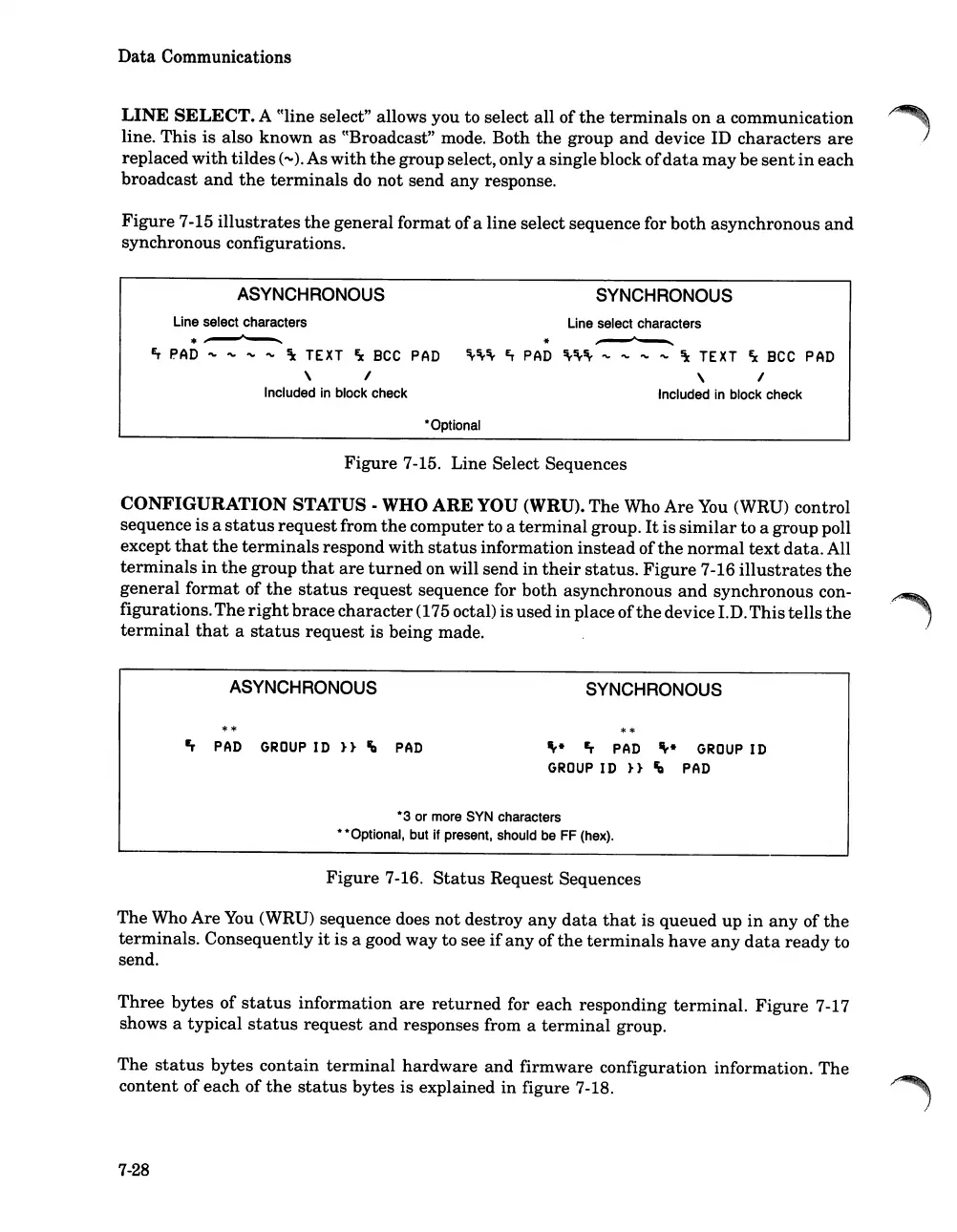
Figure
7-15
illustrates
the
general
format
ofa
line select sequence for
both
asynchronous
and
synchronous configurations.
ASYNCHRONOUS
Line select characters
.
~
"
~
PAD
~
~
"-
~
\
TEXT
~
Bee
PAD
, I
Included in block check
SYNCHRONOUS
Line select characters
, ,
~~~
~
PAD
~~~
~ ~ ~ ~
\
TEXT
~
Bee
PAD
, I
Included in block check
*Optional
Figure
7-15. Line Select Sequences
CONFIGURATION STATUS - WHO
ARE
YOU (WRU).
The
Who
Are
You
(WRU) control
sequence
is
a
status
request
from
the
computerto a
terminal
group.
It
is
similar
to a group poll
except
that
the
terminals
respond
with
status
information
instead
of
the
normal
text
data.
All
terminals
in
the
group
that
are
turned
on will send
in
their
status.
Figure
7-16
illustrates
the
general
format
of
the
status
request
sequence for
both
asynchronous
and
synchronous con-
figurations.
The
right
brace
character
(175 octal)
is
used
in
place of
the
device LD.
This
tells
the
terminal
that
a
status
request
is
being
made.
ASYNCHRONOUS
**
~
PAD
GROUP
ID
}}
~
PAD
SYNCHRONOUS
**
~.
~
PAD
~.
GROUP
ID
GROUP
ID
}}
~
PAD
*3 or more
SYN
characters
**Optional, but
if
present, should be FF (hex).
Figure
7-16.
Status
Request Sequences
The
Who
Are
You
(WRU) sequence does
not
destroy
any
data
that
is
queued
up
in
any
of
the
terminals.
Consequently
it
is
a good way to see
if
any
of
the
terminals
have
any
data
ready
to
send.
Three
bytes
of
status
information
are
returned
for each responding
terminal.
Figure
7-17
shows a typical
status
request
and
responses from a
terminal
group.
The
status
bytes
contain
terminal
hardware
and
firmware
configuration information.
The
content
of
each
of
the
status
bytes is explained
in
figure 7-18.
')
7-28












 To Next Page