Display
Control
INTRODUCTION
4
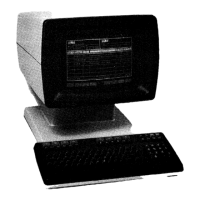
The
display
portion
of
the
terminal
consists
of
display
memory
and
the
display
screen.
Display
memory
is
the
portion
of
terminal
memory assigned
to
contain
the
alphanumeric
data
entered
into
the
terminal
for display on
the
screen.
The
display
screen
consists of 27
lines;
each
line
contains
space for 80
characters.
The
first
24
lines
are
used
to display one
((page"
of
display memory, rows 25
and
26 display
the
function
key
labels,
and
row 27
contains
information
on
the
terminals
operation
status.
On
the
HP
2625A, display memory is partioned into 2 workspaces, one each for
the
HP
and
IBM
personalities.
At
any given time, one workspace is active (that is, accessible for display
and for receiving
data
through
the
keyboard). The display cursor, a blinking underscore mark
on
the
screen or blinking inverse video box
that
indicates where
the
next character
entered
will appear, is always
present
in
the
active window.
You
can
perform
the
following display control operations
either
locally from
the
keyboard
or
remotely from a
program
executing
in
a
host
computer (these
operations
apply only to
the
terminals
HP
personality).
• Move
the
cursor
up, down, left,
or
right.
• Move
the
displayed
data
up
or
down
in
relation
to
the
current
cursor
position
(this
is
referred
to
as
(trolling"
data
on
the
screen). When a roll
operation
forces
data
off
the
top
or
bottom
edge
of
the
screen,
additional
data
rolls onto
the
screen
at
the
opposite edge.
•
Change
the
data
displayed on
the
screen to
the
next
or
previous
((page"
of
data
in
the
workspace. A
page
is a sequence
of
24 lines of
data
(the
number
of
lines
that
can
be
displayed on
the
screen).
•
Set
or
clear
a
left
and
right
margin.
•
Set
or
clear
one
or
more
tab
stop positions.
• Move
the
cursor
forward to
the
next
tab
stop position
or
backward
to
the
preceding
tab
stop
position.
•
Enable
or
disable
the
inverse
video,
half
bright,
underline,
blinking,
and/or
security
dis-
play
enhancements.
4-1




 To Next Page