EasyManua.ls Logo

HP 262SA - Full Duplex Operation; Pacing Mechanisms

HP 262SA
390 pages
Print Icon
To Next Page IconTo Next Page
To Previous Page IconTo Previous Page
Loading...
~."":"'"''''
~
Data
Communications
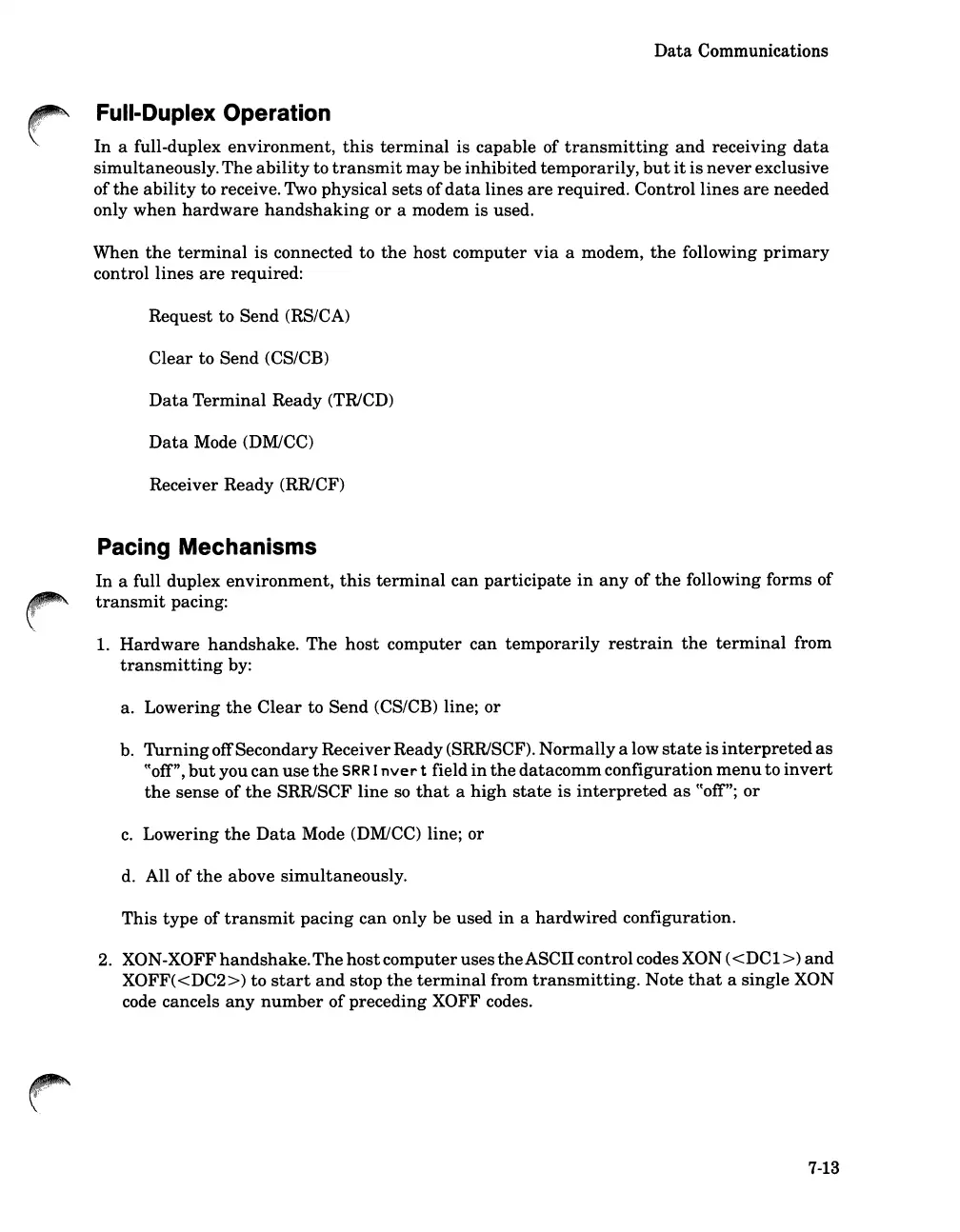
Full-Duplex Operation
In
a full-duplex
environment,
this
terminal
is capable of
transmitting
and
receiving
data
simultaneously.
The
ability
to
transmit
may
be inhibited temporarily,
but
it
is
never
exclusive
of
the
ability
to receive. Two physical
sets
of
data
lines
are
required. Control
lines
are
needed
only
when
hardware
handshaking
or a modem is used.
When
the
terminal
is connected to
the
host computer
via
a modem,
the
following
primary
control
lines
are
required:
Request to
Send
(RS/CA)
Clear
to Send (CS/CB)
Data
Terminal
Ready (TRlCD)
Data
Mode
(DMlCC)
Receiver Ready (RRlCF)
Pacing Mechanisms
In
a full duplex
environment,
this
terminal
can
participate
in
any
of
the
following forms of
transmit
pacing:
1.
Hardware
handshake.
The
host
computer can
temporarily
restrain
the
terminal
from
transmitting
by:
a. Lowering
the
Clear
to Send (CS/CB) line;
or
b.
Turning
offSecondary ReceiverReady (SRRlSCF).
Normally
a low
state
is
interpreted
as
ttoff",
but
you
can
use
the
SRR
Inver
t field
in
the
datacomm
configuration
menu
to
invert
the
sense of
the
SRRISCF
line
so
that
a
high
state
is
interpreted
as
ttoff";
or
c.
Lowering
the
Data
Mode (DMlCC) line; or
d. All
of
the
above simultaneously.
This
type
of
transmit
pacing
can
only be used
in
a
hardwired
configuration.
2. XON-XOFF
handshake.
The
host
computeruses
the
ASCIIcontrol codes XON
«DCI»
and
XOFF«DC2»
to
start
and
stop
the
terminal
from
transmitting.
Note
that
a single XON
code cancels
any
number
of
preceding XOFF codes.
7-13

Table of Contents

Related product manuals