Section 2 --- Driving & Safety
The Executive 2005
42
Ascending a Grade:
When approaching an uphill grade, assess the grade and length before beginning the climb. Prepare
early for long climbs. Unlike gasoline engines, diesels do not necessarily produce more power by press-
ing further on the accelerator! A gasoline engine will happily work at full throttle (at least for a short
period of time), but a diesel usually just wastes fuel at full throttle. The power output from a diesel
engine is dependent upon the following:
• RPM - Every engine has a range of RPM that produces power most efficiently.
• Fuel/Air mixture - At a given RPM, the engine, even with the help of a turbo-charger,
can only "pump" a given volume of air into the combustion chamber. This volume of
air can efficiently combine with only so much fuel; so it follows logically that feeding
more fuel to the fire will simply waste fuel.
Determine ranges where the motorhome works best by driving long grades when temperatures
remain stable for the duration of the climb.
IMPOR
TANT
SAFETY TIP:
If the road speed degrades to the point where the motorhome is moving significantly
below the posted speed, turn on the four way flashers. Take advantage of pullouts if
traffic is building. Once in the pullout, if there is sufficient clearance for safety, take a
break. Idle the engine to allow the exhaust and the turbo to cool. While these are cool-
ing, the transmission also cools. Monitor the gauges and enjoy the view while you wait.
Descending a Grade:
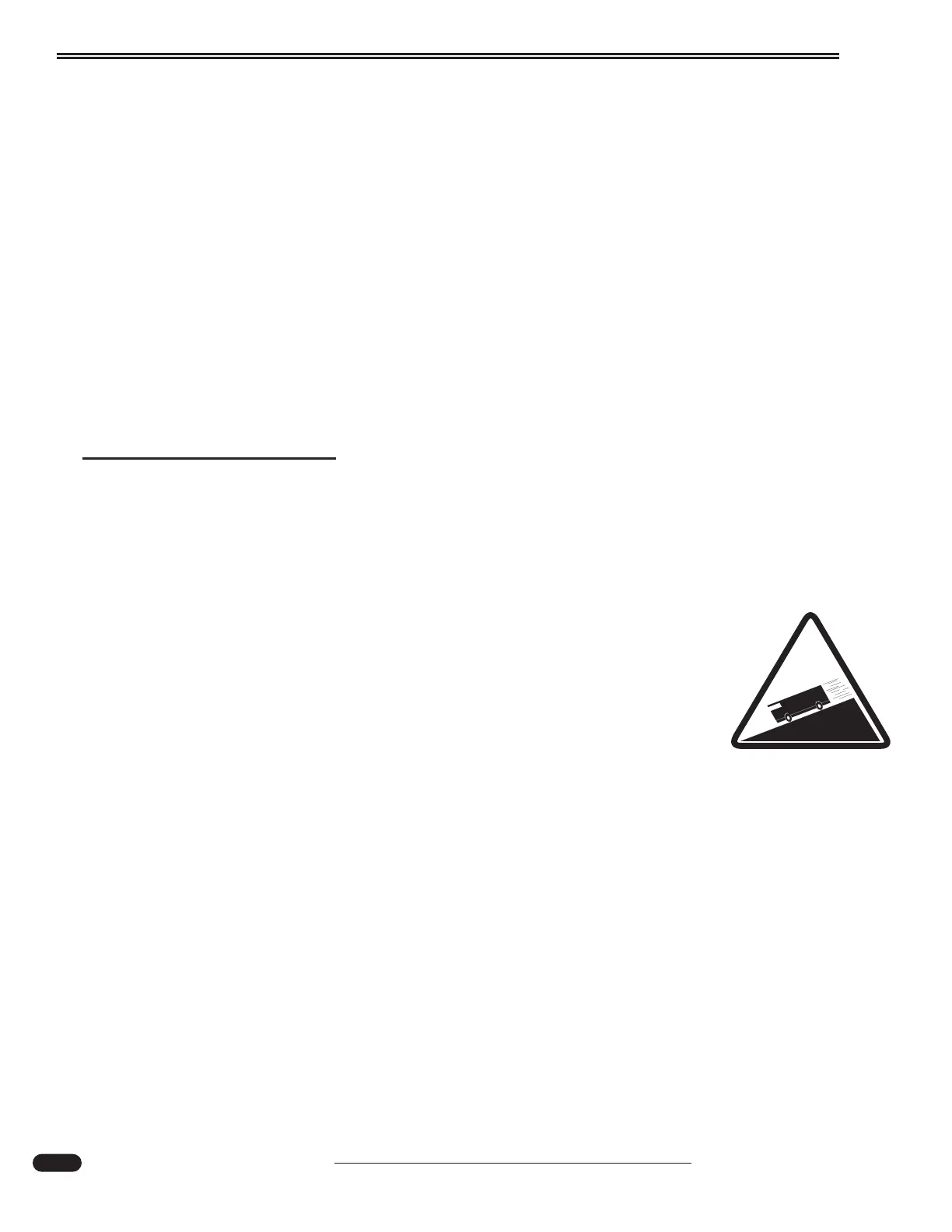
Prepare to descend a grade at the crest of the hill. Observe any signs indicating
grade angle and duration. The sign may suggest maximum downhill speed according
to Gross Combined Weight (the combined weight of the motorhome and a
trailer/tow car). At the crest of the hill, manually shift the transmission into a lower
gear. Do not allow the motorhome to gain momentum before slowing down. Use the
engine brake (Jacobs Brake) to help maintain a slow safe downhill speed. Located
on the Driver Side console is an Engine Brake switch and a brake Hi/Low switch.
When the engine brake switch is on, the engine brake will activate when the throttle
is released. The brake Hi/Low switch sets the amount of engine braking force.
When set to Hi, the engine brake will use all six cylinders. When set to Lo, only
three cylinders are used.
With engine brake applied, road speed may increase until the transmission auto-
matically upshifts to the next higher gear. Apply the brakes using moderately heavy
pressure on the brake pedal to reduce speed and manually downshift to maintain a
safe slow speed. Do not "pump" the brakes as this can result in a loss of air pressure.
Avoid "riding" the brakes as this can cause the brakes to overheat. Either method
can result in loss of brake effectiveness or brake failure.
downhill



 To Next Page