Chassis Information --- Section 10
The Executive 2005
453
U-Joint Angles, Phasing & Drive Shaft Balance
Correct U-joint working angles, U-joint phasing, and drive shaft balance is vital to maintaining a
quiet-running drivetrain and long life of drivetrain components (including drive shaft components).
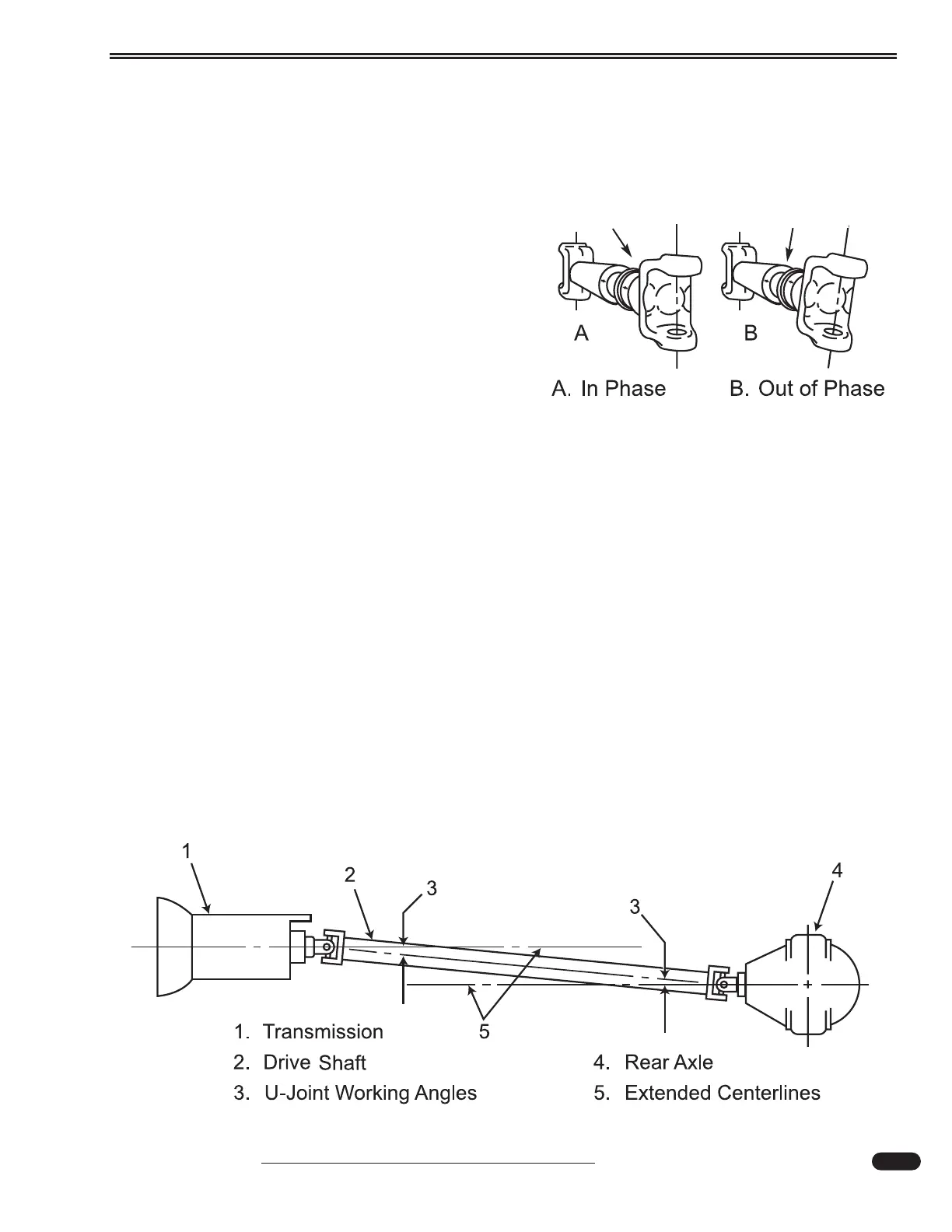
When in phase, the slip yoke lugs (ears) and
tube yoke lugs (ears) are in line. Normally this is
the ideal condition and gives the smoothest run-
ning shaft. There may be an alignment arrow
stamped on the slip yoke and on the tube shaft to
assure proper phasing when assembling these
components. If there are no alignment marks, they
should be added before disassembly of the shaft to
assure proper reassembly.
Phasing is relatively simple on a two-joint set, be sure that the slip yoke lugs and the tube yoke lugs
are in line.
The U-Joint working angle is the angle formed by the intersection of the drive shaft centerline and
the extended centerline of the shaft of any component to which the U-joint connects. Because the dou-
ble oscillating motion of a U-joint that connects angled shafts causes a fluctuating speed difference
between the shafts, the effect created by the U-joint at one end of the shaft must cancel the effect creat-
ed by the U-joint at the other end. This is done by making U-joint working angles at both ends of the
drive shaft approximately equal, with the U-joints in phase. If the yoke lugs at both ends of the
shaft are lying in the same plane (a plane which bi-sects the shaft lengthwise), the U-joints will be in
phase.
Any condition which allows excessive movement of a drive shaft will cause imbalance: loose end
yoke nuts, loose U-joint bearing cap retaining capscrews, worn U-joint trunnions, bearings and worn
slip-joint splines.
Among the most common causes of U-joint and slip joint damage is lack of lubrication. To keep the
motorhome operating smoothly and economically, the drive shaft must be carefully checked and lubri-
cated at regular intervals.
090337
Slip Yoke
Tube Yoke
090336 modified



 To Next Page