157
Chapter 9: LightField and Dual Image
Feature
The purpose of the PI-MAX4 Dual Image Feature (DIF) is to acquire a pair of gated images
in rapid succession. The time between frames can be as short as 450 ns: the second image
will have some remnants from the first image due to the longer persistence of the P46
phosphor. Exposure times can be as short as 500 ps
1
. The DIF capability is ideally suited to
capturing rapidly evolving events.
These experiments will fall into one of two broadly applicable categories:
• Readout Per Trigger (i.e., single trigger,) experiments;
These experiments require only one trigger input, and typically are events that
evolve over time, such as a laser-induced plasma or luminescence decay.
• Shift Per Trigger (i.e., dual trigger,) experiments.
These experiments require two independent trigger inputs separated in time, such as
double laser pulse velocimetry measurements.
The PI-MAX4:1024i is currently the only PI-MAX4 camera on
which DIF is supported.
9.1 Requirements
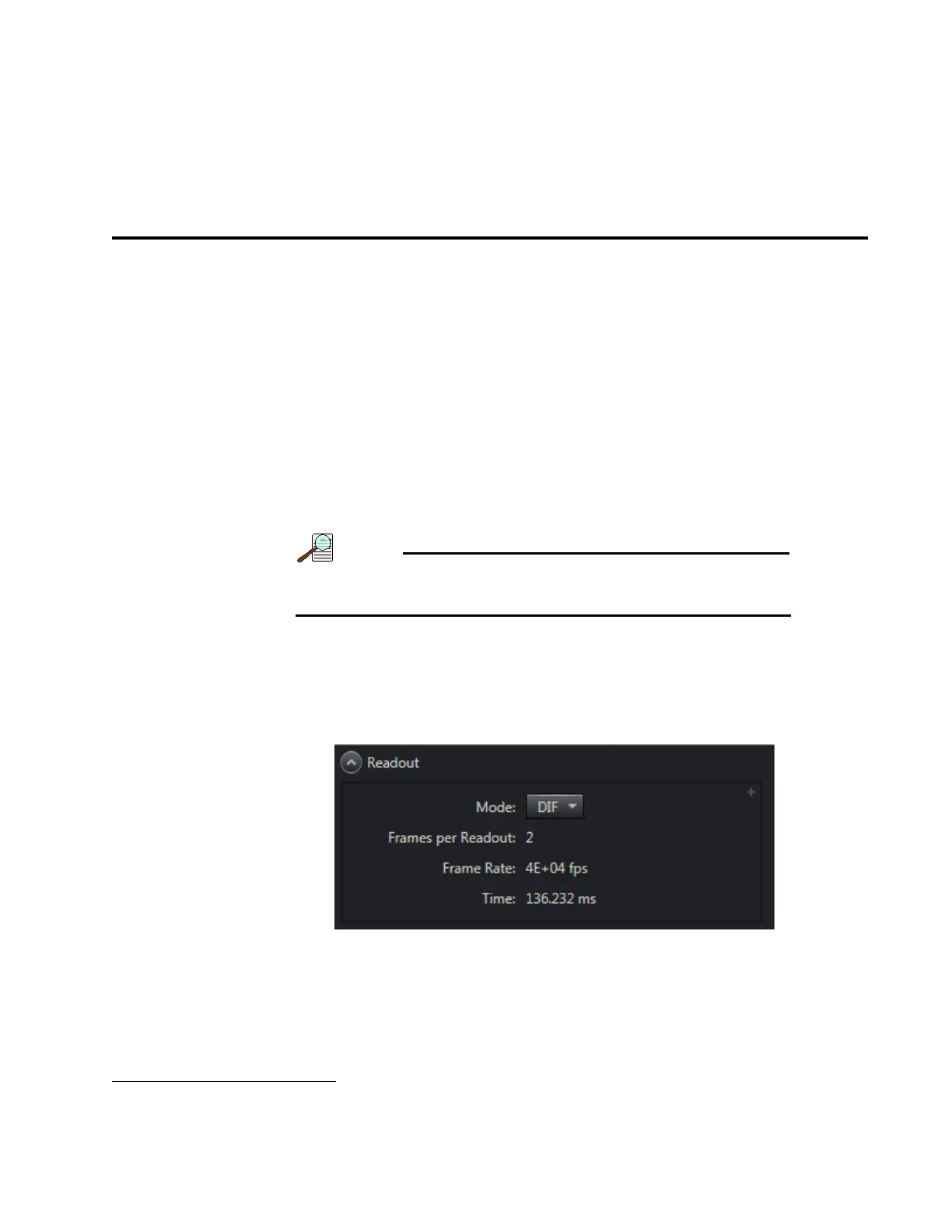
For DIF operation, the PI-MAX4 must use an interline CCD and DIF must be the selected
Mode on the Readout expander,. See Figure 9-1.
Figure 9-1: Readout Expander
1 Requires additional hardware. Refer to Chapter 12, Picosecond Gating Option, on page 191 for additional information.


 To Next Page