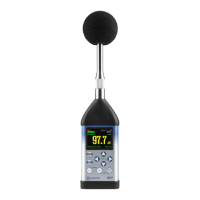
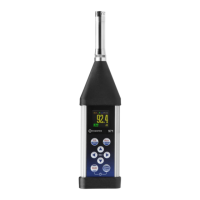
Linear operating ranges with the SA 22 windscreen
See Chapter C.1.2.
RMS detector
• Digital “True RMS“ with Peak detection,
• Resolution 0.1 dB
• Range 327.7 dB
• Crest Factor unlimited (for signals in 20 kHz band).
Overload detector
The instrument has the built-in overload detectors. The overload in the measurement channel (in its analogue
part) and the overload of the analogue / digital converter are both detected. The “overload” indication is when
the input signal amplitude is 0.5 dB above the declared “Peak measurement range”.
Underrange detector
The instrument has the built-in underrange detector. The “underrange” indication appears when the minimum
value of the RMS detector output goes below the specified lower linear operating range.
Time weighting characteristics (Exponential averaging)
Slow “S“ according to IEC 61672-1:2013 Class 1, Equivalent Time Constant 1000 ms
Fast “F” according to IEC 61672-1:2013 Class 1, Equivalent Time Constant 125 ms
Impulse “I” according to IEC 60804 Class 1, Equivalent Time Constant 35 ms, Hold Time 1500 s
Reference conditions
• Class of the acoustic field Free field
• Reference acoustic pressure 114.0 dB (related to 20 Pa)
• Reference frequency 1000 Hz
• Reference temperature +20°C
• Reference relative humidity 65 %
• Reference static pressure 1013 hPa
• Reference incidence direction perpendicular to the microphone diaphragm.


 To Next Page