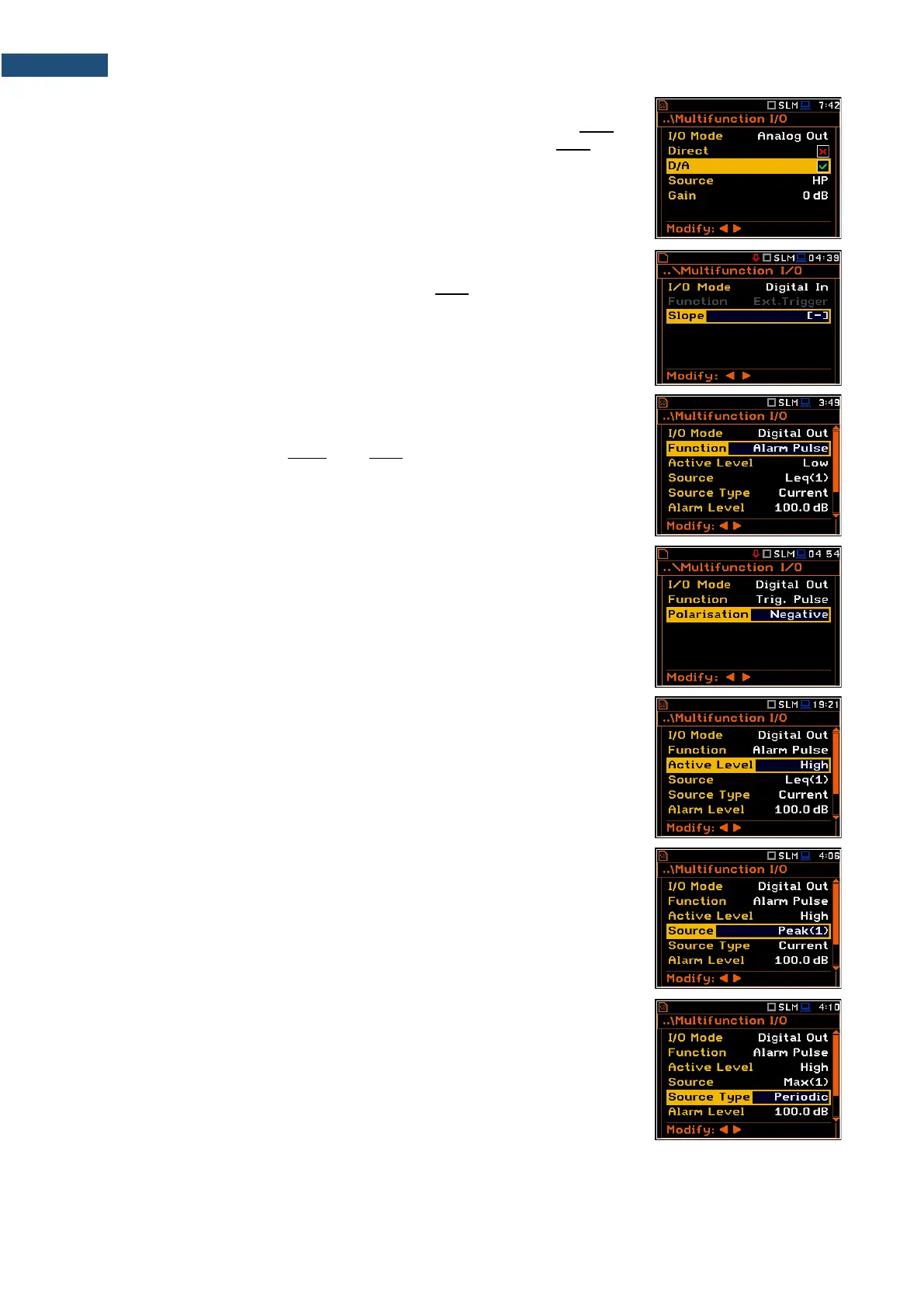
When D/A is selected, the analogue signal from the internal signal generator of
the instrument after digital-to-analogue converter is transmitted to the pin 1 of
the I/O connector, and the analogue input signal is transmitted to the pin 2 of the
I/O connector after digital-to-analogue converter.
The input signal can be weighted with HP, Z, A, C or B filter (Source) and
additionally gained by -60 dB to 60 dB (Gain).
Digital In mode (External trigger function)
In the Digital In mode, the signal appeared on the pin 2 of the I/O socket will be
treated as an external trigger if the External trigger was chosen (path: <Menu>
/ Measurement / Measurement Trigger / Trigger: External or <Menu> /
Measurement / Logging / Trigger: External). In the Digital In mode the Function
parameter is set to Ext.Trigger. It is possible to select the trigger voltage slope:
[+] (uprising as default) or [–] (falling).
Function of the Digital Out mode
The Function position allows you to select the function of the digital output of
the I/O instrument’s socket (pin 2). The pin 2 of the socket can be used as a
source of the trigger pulse (Trigger Pulse) which starts the measurement in
another “slave instrument” linked to the “master instrument” or as an alarm
signal, which appears there after fulfilment of certain conditions (Alarm Pulse).
Polarisation of the digital output trigger pulse
The Polarisation parameter defines the output trigger pulse polarisation:
Negative or Positive.
Active level of the alarm pulse
The Active Level parameter defines which level of the signal should be treated
as a valid one: Low or High (“negative” or “positive” logic).
Alarm trigger result
The Source parameter defines the result, the level of which should be checked
and compared with the threshold level for the alarm triggering. If the result level
is greater than the threshold level (Alarm Level), the instrument will generate
an alarm signal on the I/O socket. The results from the first profile: Leq(1),
Peak(1), Max(1) or Spl(1) can be selected as an alarm trigger source.
Type of Alarm source
The Source Type parameter defines the type of an alarm source: Current or
Periodic.
Current means that the alarm pulse will be generated all the time when the
Source result averaged with 1-second step is over the Alarm Level value.
Periodic means that the alarm pulse will be generated all the time when the
Source result averaged with Integration Period step is over the Alarm Level
value.


 To Next Page