About ML700
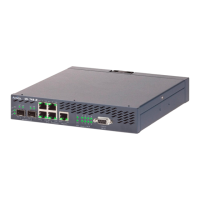
Actelis Networks ML700 Ethernet Access Devices (EAD) is further complementing Actelis
ML 600 product line, through offering a cost-effective delivery of Ethernet in the First Mile
(EFM) high-speed Carrier Ethernet services over the existing copper infrastructure.
The ML700 is designed for point-to-point topologies as well as a CPE only product, working
with approved 3
rd
party DSLAM vendors, serving backhauling of IP DSLAM and cellular
base stations and delivering asymmetrical Ethernet traffic, using EFMPlus Bonding over
multiple copper pairs with xDSL transmission.
ML700 models offers extended rate and reach performance through bonding of DMT
(ADSL2, ADSL2plus and VDSL2) technologies. The choice between the technologies can be
made either manually (user selected) or it can be automatically selected by the system from a
list of allowed xDSL technologies.
All ML700 models support a single EFM Bonding interface – High Speed Link (HSL). The
HSL represents an Ethernet-like logical port that contains up to 8 (model dependent) xDSL
ports.
ML700 Link performance may be farther increased on long loops by deploying Actelis’ BBA
(Broadband Accelerator) amplifiers in the loop.
ML700-O and ML700-R models are not convertible; thus appropriate models should be used
on Central Office and Customer Premises Equipment.
ML700 Capabilities
Ethernet traffic throughput: 500Mbps (Downstream)/250Mbps (Upstream)
Fully configurable xDSL transport layer, using TR-165 and TR-252 Vector of Profiles
management model
Enhanced DSL robustness using SRA (Seamless rate Adaptation), G.998.4
(retransmission) and INM (Impulse Noise Monitoring)
Ethernet ports – 4x10/100Base-TX and 2x100/1000Base-FX ports, with various SFP
modules supported
Advanced QOS features, fully compliant to MEF10.2 standard
ML700 models support Ethernet OAM, fully compliant to 802.3ah OAM, 802.1ag CFM
and Y.1731 Ethernet OAM standards
ML700-R models – interoperable with most IP/ Ethernet DSLAM, supporting IEEE
802.3ah Ethernet Packet Transport Mode (PTM), with EFM Bonding (aggregation over
multiple copper pairs), with or without vectoring.


 To Next Page