Ethernet Operation, Administration and Management Y.1731 Ethernet OAM
Click the View Unbound RMEPs button to view discovered in the same MEG MEPs on
other NEs.
Up to 20 MEPs can be shown, records are not aged.
To refresh information (addition /removal of MEP on neighbor NEs) , click Delete All
inside the dialog.
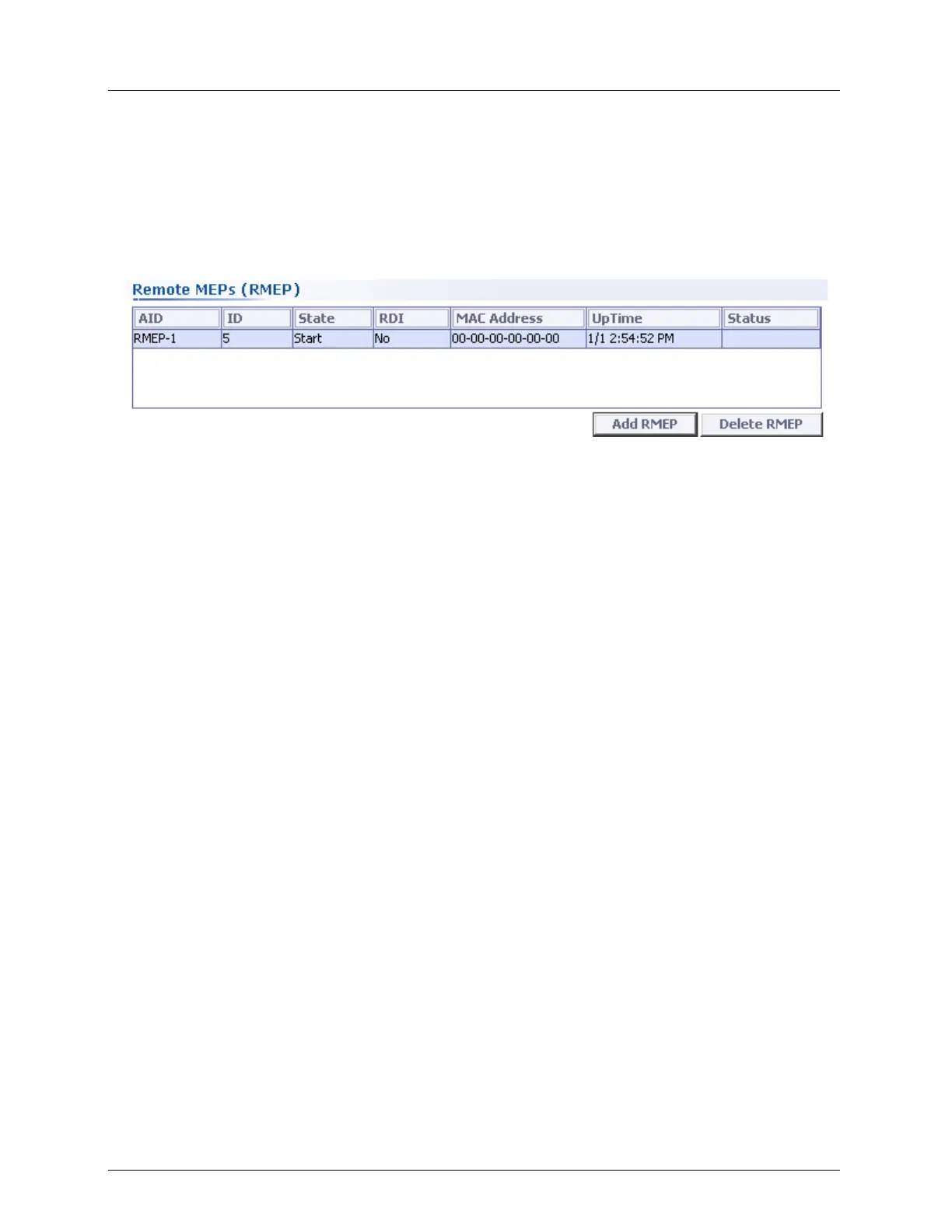
State and Status of RMEP is monitored in a table:
Y.1731 Tools
There are two main areas of OAM: connectivity fault management and service performance
monitoring. Connectivity Fault management functionalities of Y.1731 and CFM 802.1ag
modes are equal. See CFM MEP Monitoring and Analysis Tools (on page 11-10).
Y.1731, additionally provides Performance Monitoring functionality implemented on ML NE
as defined below.
ML units provide raw counters for the following:
Current 15min and 1-day intervals (start of PM counters can be set per system)
Previous 8 hours (15min x 36 intervals)
Previous 1-day interval
See Performance Monitoring. Y.1731 Performance data is available via MAV GUI, TL1 and
SNMP (proprietary Actelis MIB). The following counter types are available:
Frame Loss - is implemented using CCM representative traffic. Standard CCM with
Sequence Number that is not in use (i.e. permanently set to 0) utilizes TX/RX counter
fields to count CCM frames lost - suitable for point-to-point (E-Line) deployment only.
Sequence Number incremented within each CCM sent by each MEP (non-standard
solution) allows frame lost monitoring per each Remote MEP individually – which is
suitable for all point-to-multipoint deployments.
Frame Loss Ratio – is implemented using Frame Loss counters (see above) , being
calculated and updated each 1-minute. To calculate FLR over an interval (1-minute, 15-
min or 1-day), total FL is divided to Total number of Rx Frames arrived during the
interval.
Round Trip Frame Delay – is implemented using ETH-DM/DMR unicast messages, as
an average delay measured during the interval, monitored per each MEP-to-RMEP
connection individually. Provided in microsec units.


 To Next Page