AFH Processing Adaptive Frequency Hopping (Option 15)
15-2 PN: 13000-00205 Rev. N MT8852B Operation Manual
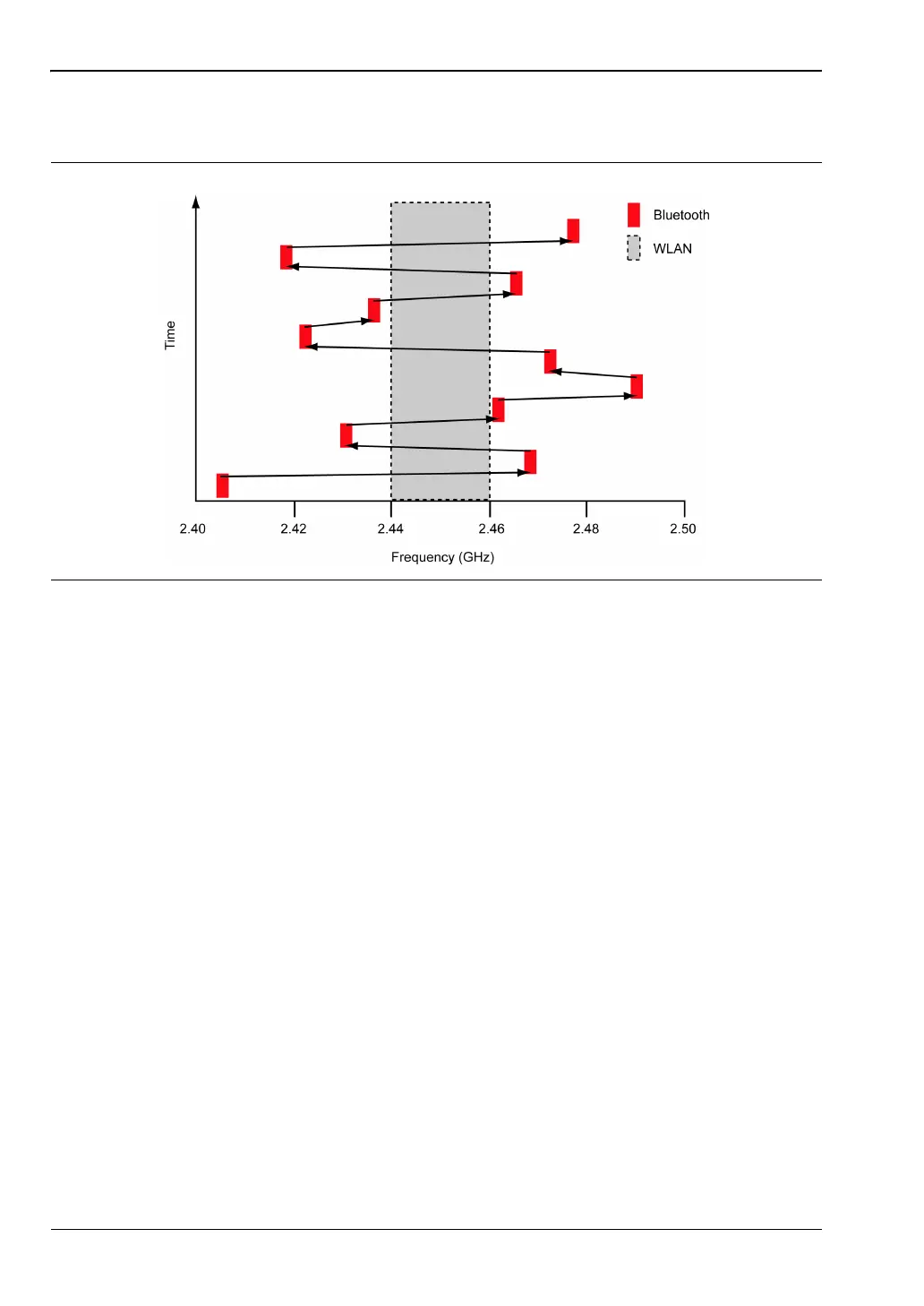
When AFH is enabled, the channels in use by WLAN are excluded and the Bluetooth packets
are restricted to other channels where there is little probability of interference.
15-2 AFH Processing
AFH allows Bluetooth devices to adapt to the environment by identifying sources of
interference and then omitting them from the list of channels available for use.
To use AFH on a connection, both master and slave devices must support the feature, and the
master selects whether or not to enable its use. When enabled, the master device generates a
channel map to inform the slave device which of the 79 channels are available for use and
which have been excluded.
The channel map is generated based on information from any or all of the following three
sources.
• Channel classification sent over the HCI from the Host Controller. This would be
applicable in the case of a PC supporting both Bluetooth and WLAN.
• The results of monitoring in the master device to build up a picture of which channels
are experiencing interference problems. This information is referred to as the master's
local assessment scheme (MLAS).
• The results of monitoring in the slave device to build up a picture of which channels are
experiencing interference problems. This information is referred to as the slave's local
assessment scheme (SLAS) and is relayed back to the master in channel classification
reports.
Figure 15-2. Adaptive Frequency Hopping









 To Next Page