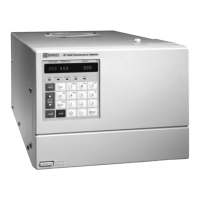
ICS-3000 Ion Chromatography System
226 Doc. 065031-04 1/08
8.28.6 Shift in Ag/AgCl Reference Potential
• Faulty reference electrode
A shift in reference potential causes a shift in the effective potential
applied to the working electrode. For example, when using an
electrode with a shift of 50 mV, an applied potential of 0.1 V, is
equivalent to an applied potential of 0.15 V for a new reference
electrode with no shift.
Following the steps below, measure the Ag/AgCl reference electrode
potential shift by comparing it to the potential shift of an unexposed
electrode. A spare reference electrode (P/N 061879) stored in 3 M
KCl can be kept on hand for this purpose.
Using a Digital Voltmeter to Determine Reference Potential Shift
1. Using the reference electrode adapter cable, connect the voltmeter’s
test probes to the center sockets of the unexposed electrode and the
reference electrode being tested.
2. Immerse both reference electrodes in a solution of 0.1 M KCl.
3. Read the potential difference (in mV) between the unexposed
electrode and the electrode being tested. If it is greater than 50 mV,
try regenerating the electrode by soaking it in a solution containing
1 M KCl and 1 M HCl. If this does not reduce the potential shift,
replace the electrode (see Section 9.24.6
).


 To Next Page