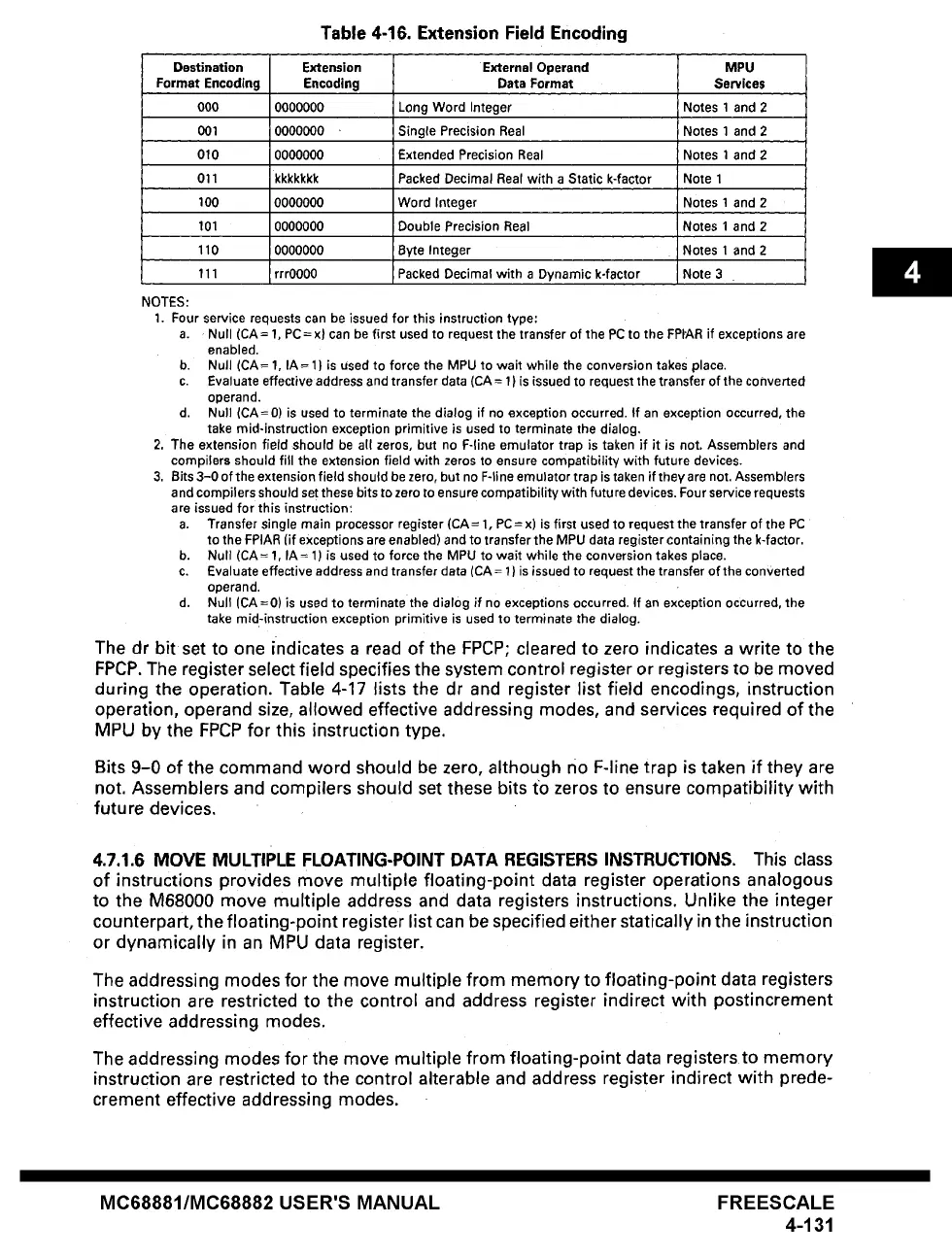
Table 4-16. Extension Field Encoding
Destination Extension External Operand MPU
Format Encoding Encoding Data Format Services
000 0O00000 Long Word Integer Notes 1 and 2
001 0000000 • Single Precision Real Notes 1 and 2
010 0000000 Extended Precision Real Notes 1 and 2
011 kkkkkkk Packed Decimal Real with a Static k-factor Note 1
100 0000000 Word Integer Notes 1 and 2
101 0000000 Double Precision Real Notes 1 and 2
110 0000000 Byte Integer Notes I and 2
111 rrr0O00 Packed Decimal with a Dynamic k-factor Note 3
NOTES:
1. Four service requests can be issued for this instruction
type:
a. Null (CA= 1, PC=x) can be first used to request the transfer of the PC to the FPI~R if exceptions are
enabled.
b. Null (CA= 1, IA= 1) is used to force the MPU to wait while the conversion takes place.
c. Evaluate effective address and transfer data (CA = 1 ) is issued to request the transfer of the converted
operand.
d. Null (CA = 0) is used to terminate the dialog if no exception occurred. If an exception occurred, the
take mid-instruction exception primitive is used to terminate the dialog,
2. The extension field should be all zeros, but no F-line emulator trap is taken if it is not. Assemblers and
compilers should fill the extension field with zeros to ensure compatibility with future devices.
3. Bits 3-0 of the extension field should be zero, but no F-line emulator trap is taken if they are not. Assemblers
and compiler s should se t these bits to zero to ensure compatibility with futu re devices. Four service requests
are
issued for this instruction:
a. Transfer single main processor register (CA= 1, PC = x) is first used to request the transfer of the PC
to the FPIAR (if exceptions are enabled) and to transfer the MPU data register containing the k-factor.
b. Null (CA = 1, IA = 1) is used to force the MPU to wait while the conversion takes place.
c. Evaluate effective address and transfer
data
(CA = 1 ) is issued to request the transfer of the converted
operand.
d. Null (CA=0) is used to terminate the dialog if no exceptions occurred. If an exception occurred, the
take mid-instruction exception primitive is used to terminate the dialog.
The dr bit set to one indicates a read of the FPCP; cleared to zero indicates a write to the
FPCP. The register select field specifies the system control register or registers to be moved
during the operation. Table 4-17 lists the dr and register list field encodings, instruction
operation, operand size, allowed effective addressing modes, and services required of the
MPU by the FPCP for this instruction type.
Bits 9-0 of the command word should be zero, although no F-line trap is taken if they are
not. Assemblers and compilers should set these bits to zeros to ensure compatibility with
future devices,
4.7.1.6 MOVE MULTIPLE FLOATING-POINT DATA REGISTERS INSTRUCTIONS. This class
of instructions provides move multiple floating-point data register operations analogous
to the M68000 move multiple address and data registers instructions. Unlike the integer
counterpart, the floating-point register list can be specified either statically in the instruction
or dynamically in an MPU data register.
The addressing modes for the move multiple from memory to floating-point data registers
instruction are restricted to the control and address register indirect with postincrement
effective addressing modes.
The addressing modes for the move multiple from floating-point data registers to memory
instruction are restricted to the control alterable and address register indirect with prede-
crement effective addressing modes.
MC66661/MC66662 USER'S MANUAL FREESCALE
4-131



 To Next Page