protocol is used to place all word registers on the upper word of the data bus (D31-D16).
This is accomplished by asserting DSACK1 and leaving DSACK0 negated when any word
Eegister (other than the register select CIR) is accessed, regardless of the value of A1.
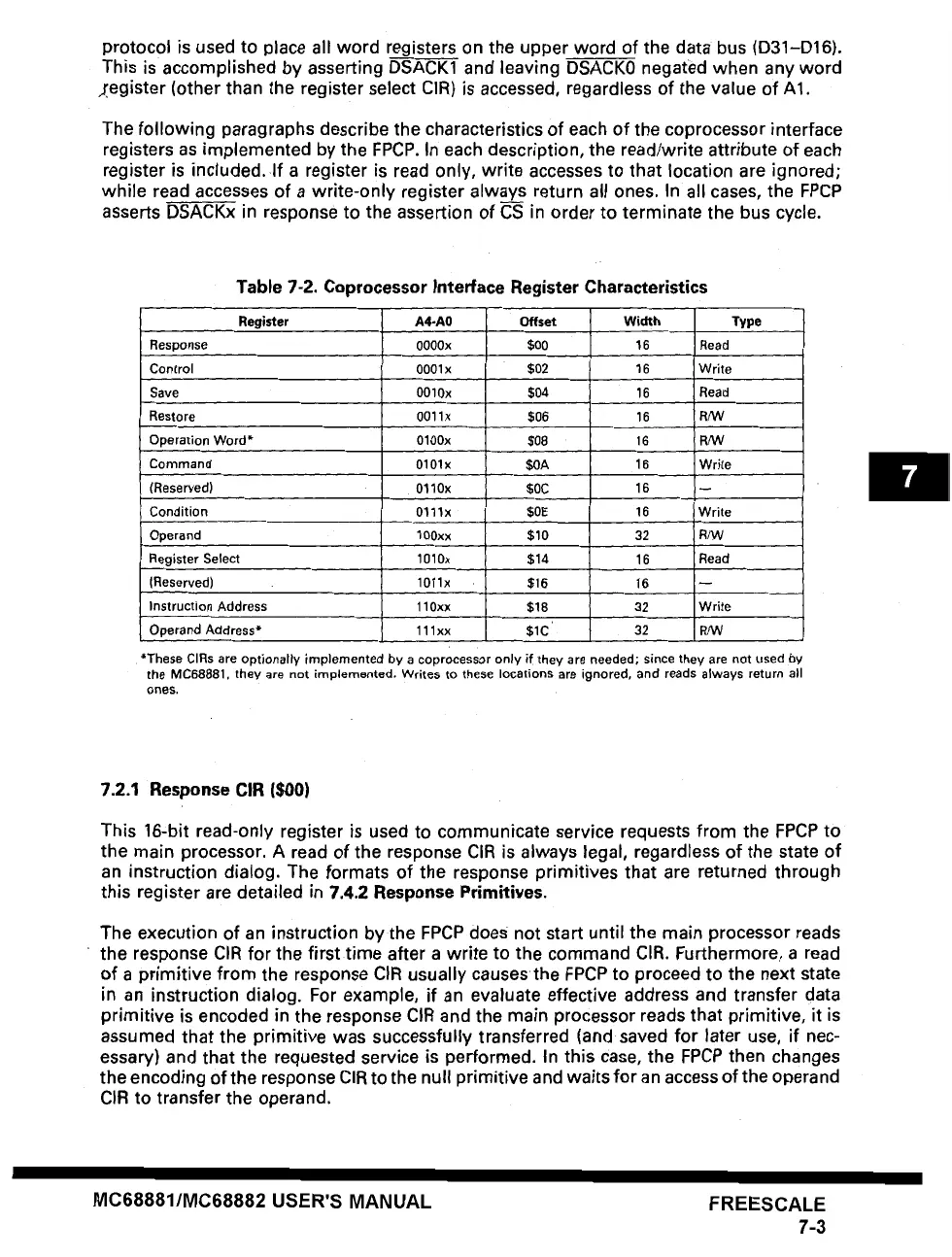
The following paragraphs describe the characteristics of each of the coprocessor interface
registers as implemented by the FPCP. In each description, the read/write attribute of each
register is included. If a register is read only, write accesses to that location are ignored;
while read accesses of a write-only register alway___s return all ones. In all cases, the FPCP
asserts DSACKx in response to the assertion of CS in order to terminate the bus cycle.
Table 7-2. Coprocessor Interface Register Characteristics
Register Width Type
Response
16
Read
Control
16
Write
Save
16
Read
Restore
16 R/W
Operation Word*
16 R/W
Command
16
Write
(Reserved)
16 --
Condition
16
Write
Operand
32 RNV
Register Select
16
Read
(Reserved)
16 --
Instruction Address 32 Write
32 RNV
Operand Address*
A4-A0 Offset
0000x
$00
0001x $02
0010x $O4
0011x $06
0100x $08
0101x $0A
0110x $0C
0111x $0E
100xx $10
1010x $14
1011x $16
110xx $18
111xx $1C
*These CIRs are optionally implemented by a coprocessor only if they are needed; since they are not used by
the MC68881, they
are
not implemented. Writes to these locations are ignored, and reads always return all
ones,
7.2.1 Response CIR ($00)
This 16-bit read-only register is used to communicate service requests from the FPCP to
the main processor. A read of the response CIR is always legal, regardless of the state of
an instruction dialog. The formats of the response primitives that are returned through
this register are detailed in 7.4.2 Response Primitives.
The execution of an instruction by the FPCP does not start until the main processor reads
the response CIR for the first time after a write to the command CIR. Furthermore, a read
of a primitive from the response CIR usually causes the FPCP to proceed to the next state
in an instruction dialog. For example, if an evaluate effective address and transfer data
primitive is encoded in the response CIR and the main processor reads that primitive, it is
assumed that the primitive was successfully transferred (and saved for later use, if nec-
essary) and that the requested service is performed. In this case, the FPCP then changes
the encoding of the response CIR to the null primitive and waits for an access of the operand
CIR to transfer the operand.
MC68881/MC68882 USER'S MANUAL FREESCALE
7-3



 To Next Page