6
17-BIT
EXPONENT
IL
@3-B}T
FRACTION
LEAST SI6N1FICANT BET OF FRACTION --
INTEGER BIT GUARD BET --
-- OVERFLOW BIT ROU,~D BIT --
S~CKY BE --
Ill
III
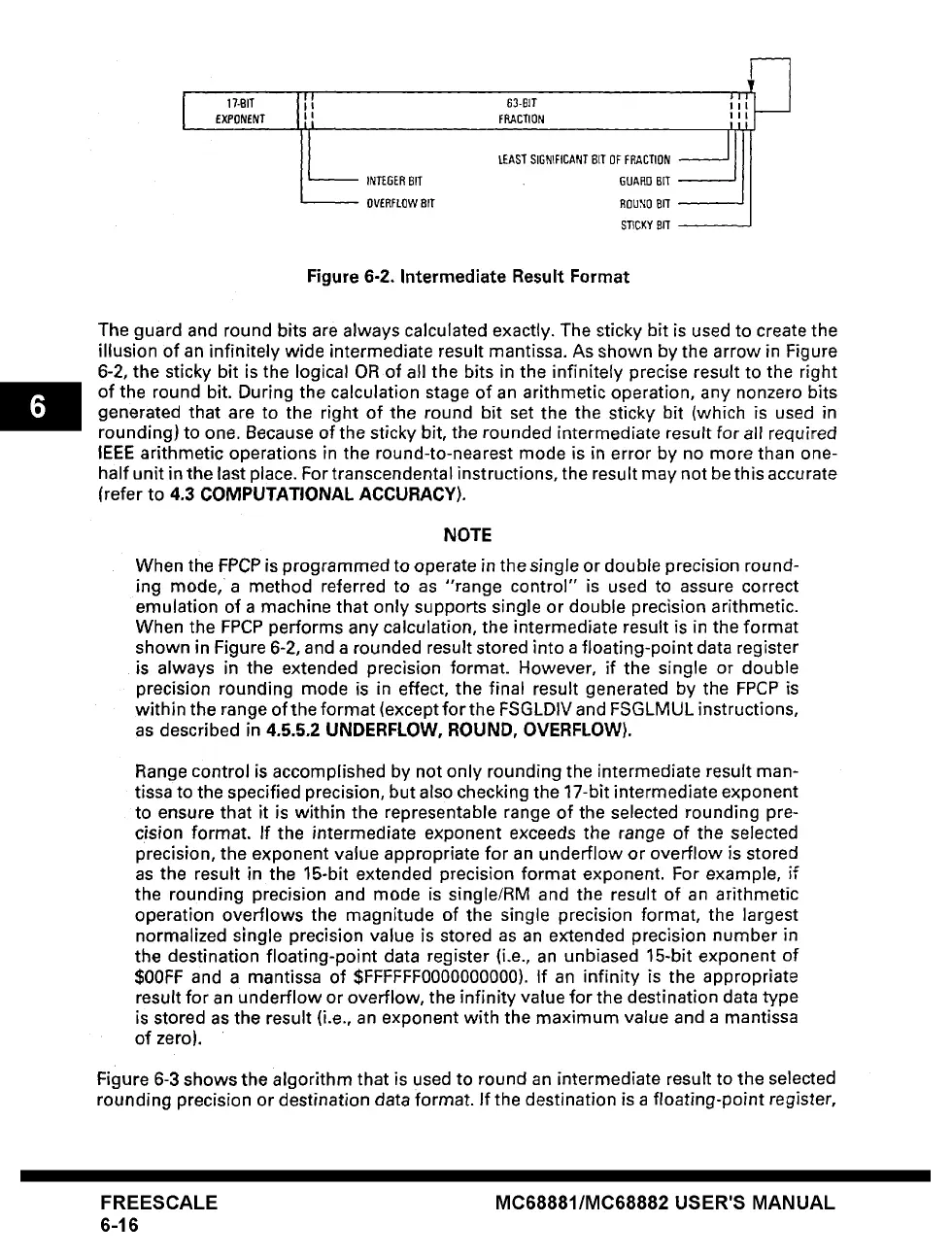
Figure 6-2, Intermediate Result Format
The guard and round bits are always calculated exactly. The sticky bit is used to create the
illusion of an infinitely wide intermediate result mantissa. As shown by the arrow in Figure
6-2, the sticky bit is the logical OR of all the bits in the infinitely precise result to the right
of the round bit. During the calculation stage of an arithmetic operation, any nonzero bits
generated that are to the right of the round bit set the the sticky bit (which is used in
rounding) to one. Because of the sticky bit, the rounded intermediate result for all required
IEEE arithmetic operations in the round-to-nearest mode is in error by no more than one-
half unit in the last place. For transcendental instructions, the result may not be this accurate
(refer to 4.3 COMPUTATIONAL ACCURACY).
NOTE
When the FPCP is programmed to operate in the single or double precision round-
ing mode, a method referred to as "range control" is used to assure correct
emulation of a machine that only supports single or double precision arithmetic.
When the FPCP performs any calculation, the intermediate result is in the format
shown in Figure 6-2, and a rounded result stored into a floating-point data register
is always in the extended precision format. However, if the single or double
precision rounding mode is in effect, the final result generated by the FPCP is
within the range of the format (except for the FSGLDIV and FSGLMUL instructions,
as described in 4.5.5.2 UNDERFLOW, ROUND, OVERFLOW).
Range control is accomplished by not only rounding the intermediate result man-
tissa to the specified precision, but also checking the 17-bit intermediate exponent
to ensure that it is within the representable range of the selected rounding pre-
cision format. If the intermediate exponent exceeds the
range
of the selected
precision, the exponent value appropriate for an underflow or overflow is stored
as the result in the 15-bit extended precision format exponent. For example, if
the rounding precision and mode is single/RM and the result of an arithmetic
operation overflows the magnitude of the single precision format, the largest
normalized single precision value is stored as an extended precision number in
the destination floating-point data register (i.e., an unbiased 15-bit exponent of
$00FF and a mantissa of $FFFFFF0000000000). If an infinity is the appropriate
result for an underflow or overflow, the infinity value for the destination data type
is stored as the result (i.e., an exponent with the maximum value and a mantissa
of zero).
Figure 6-3 shows the algorithm that is used to round an intermediate result to the selected
rounding precision or destination
data
format. If the destination is a floating-point register,
FREESCALE
6-16
MC68881/MC68882 USER'S MANUAL



 To Next Page