7
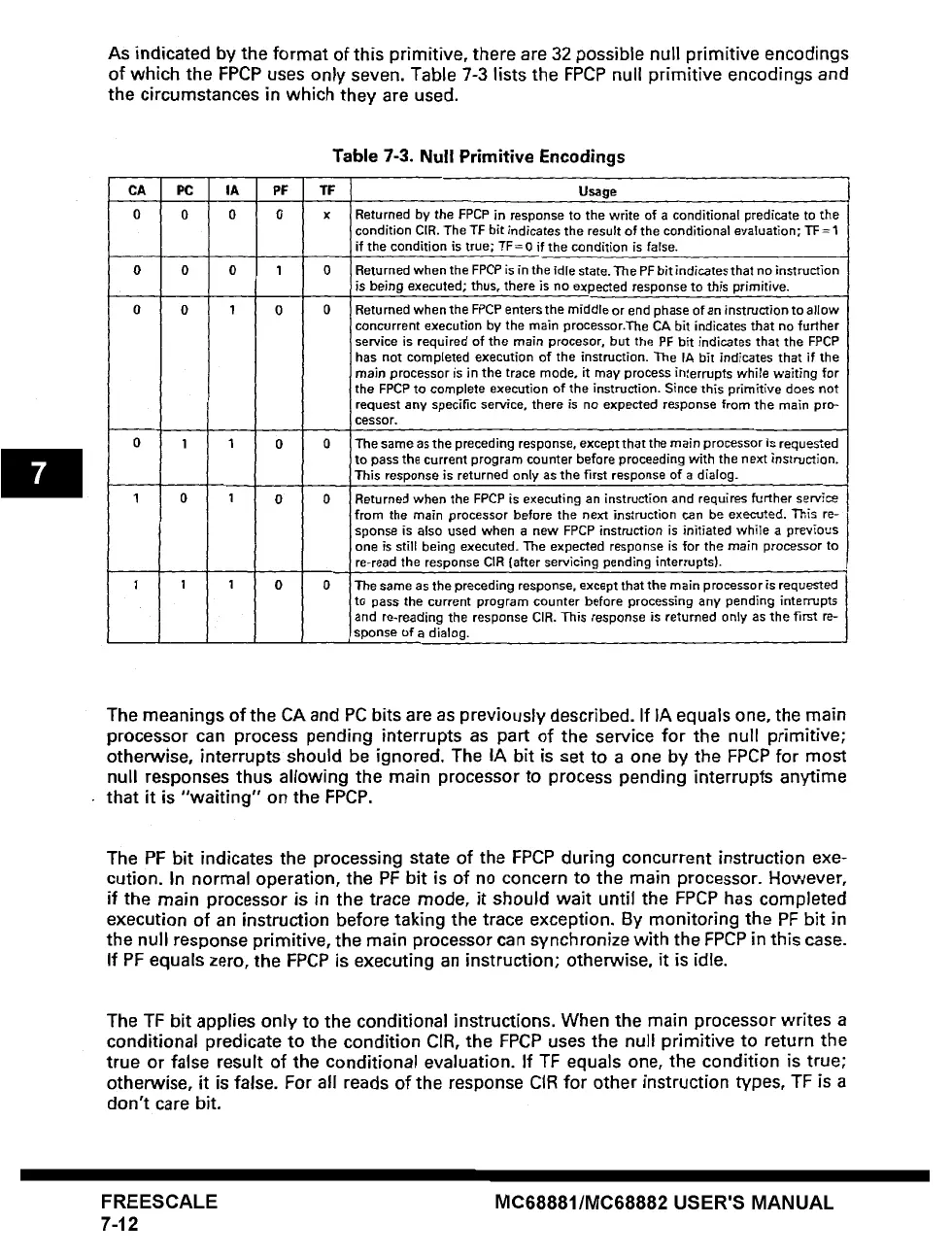
As indicated by the format of this primitive, there are 32 possible null primitive encodings
of which the FPCP uses only seven. Table 7-3 lists the FPCP null primitive encodings and
the circumstances in which they are used.
CA PC IA PF TF
0 0 0 0 x
0 0 0 1
0 0 1 0
0 1 1 0 0
1 0 1 I 0 0
1 1 1 0 0
Table 7-3. Null Primitive Encodings
Usage
Returned by the FPCP in response to the write of a conditional predicate to the
condition CIR. The TF bit indicates the result of the conditional evaluation; TF = 1
if the condition is true; TF=0 if the condition is false.
0 Returned when the FPCP is in the idle state. The PF bit indicates that no instruction
is being executed; thus, there is no expected response to this primitive.
Returned when the FPCP enters the middle or end phase of an instruction to allow
concurrent execution by the main processor.The CA bit indicates that no further
service is required of the main procesor, but the PF bit indicates that the FPCP
has not completed execution of the instruction. The IA bit indicates that if the
main processor is in the trace mode, it may process interrupts while waiting for
the FPCP to complete execution of the instruction. Since this primitive does nat
request any specific service, there is no expected response from the main pro-
cessor.
The same as the preceding response, except that the main processor is requested
to pass the current program counter before proceeding with the next instruction.
This response is returned only as the first response of a dialog.
Returned when the FPCP is executing an instruction and requires further service
from the main processor before the next instruction can be executed. This re-
sponse is also used when a new FPCP instruction is initiated while a previous
one is still being executed. The expected response is for the main processor to
re-read the response CIR (after servicing pending interrupts).
The same as the preceding response, except that the main processor is requested
to pass the current program counter before processing any pending interrupts
and re*reading the response CIR. This response is returned only as the first re-
sponse of a dialog.
The meanings of the CA and PC bits are as previously described. If IA equals one, the main
processor can process pending interrupts as part of the service for the null primitive;
otherwise, interrupts should be ignored. The IA bit is set to a one by the FPCP for most
null responses thus allowing the main processor to process pending interrupts anytime
• that it is "waiting" on the FPCP.
The PF bit indicates the processing state of the FPCP during concurrent instruction exe-
cution. In normal operation, the PF bit is of no concern to the main processor. However,
if the main processor is in the trace mode, it should wait until the FPCP has completed
execution of an instruction before taking the trace exception. By monitoring the PF bit in
the null response primitive, the main processor can synchronize with the FPCP in this case.
If PF equals zero, the FPCP is executing an instruction; otherwise, it is idle.
The TF bit applies only to the conditional instructions. When the main processor writes a
conditional predicate to the condition CIR, the FPCP uses the null primitive to return the
true or false result of the conditional evaluation. If TF equals one, the condition is true;
otherwise, it is false. For all reads of the response CIR for other instruction types, TF is a
don't care bit.
FREESCALE
7-12
MC68881/MC68882 USER'S MANUAL



 To Next Page