30
0
0
0
0
1
1
1
1
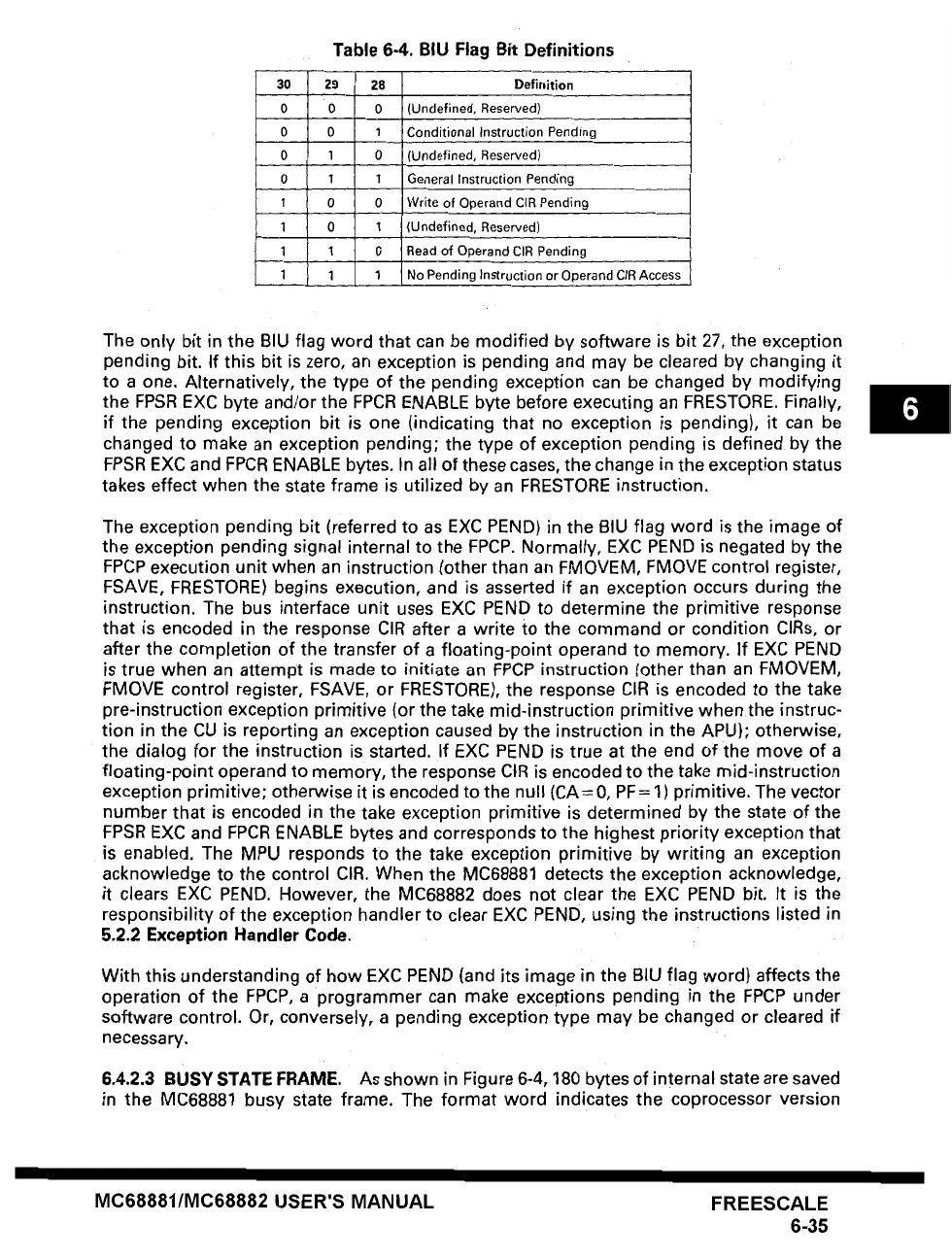
Table 6-4. BIU Flag Bit Definitions
29 28 Definition
0 0 , (Undefined, Reserved)
0 1 ' Conditional instruction Pending
1 0 ! (Undefined, Reserved)
1 1 General Instruction Pending
0 0 Write of Operand CiR Pendin 9
0 1 (Undefined, Reserved)
1 0 Read of Operand CIR Pending
1 1 No Pending Instruction or Operand CIR Access
The only bit in the BIU flag word that can be modified by software is bit 27, the exception
pending bit. If this bit is zero, an exception is pending and may be cleared by changing it
to a one. Alternatively, the type of the pending exception can be changed by modifying
the FPSR EXC byte and/or the FPCR ENABLE byte before executing an FRESTORE. Finally,
if the pending exception bit is one (indicating that no exception is pending), it can be
changed to make an exception pending; the type of exception pending is defined by the
FPSR EXC and FPCR ENABLE bytes. In all of these cases, the change in the exception status
takes effect when the state frame is utilized by an FRESTORE instruction.
The exception pending bit (referred to as EXC PEND) in the BIU flag word is the image of
the exception pending signal internal to the FPCP. Normally, EXC PEND is negated by the
FPCP execution unit when an instruction (other than an FMOVEM, FMOVE control register,
FSAVE, FRESTORE) begins execution, and is asserted if an exception occurs during the
instruction. The bus interface unit uses EXC PEND to determine the primitive response
that is encoded in the response CIR after a write to the command or condition CIRs, or
after the completion of the transfer of a floating-point operand to memory. If EXC PEND
is true when an attempt is made to initiate an FPCP instruction (other than an FMOVEM,
FMOVE control register, FSAVE, or FRESTORE), the response CIR is encoded to the take
pre-instruction exception primitive (or the take mid-instruction primitive when the instruc-
tion in the CU is reporting an exception caused by the instruction in the APU); otherwise,
the dialog for the instruction is started. If EXC PEND is true at the end of the move of a
floating-point operand to memory, the response CIR is encoded to the take mid-instruction
exception primitive; otherwise it is encoded to the null (CA= 0, PF = 1) primitive. The vector
number that is encoded in the take exception primitive is determined by the state of the
FPSR EXC and FPCR ENABLE bytes and corresponds to the highest priority exception that
is enabled. The MPU responds to the take exception primitive by writing an exception
acknowledge to the control CIR. When the MC68881 detects the exception acknowledge,
it clears EXC PEND. However, the MC68882 does not clear the EXC PEND bit. It is the
responsibility of the exception handler to clear EXC PEND, using the instructions listed in
5.2.2 Exception Handler Code,
With this understanding of how EXC PEND (and its image in the BIU flag word) affects the
operation of the FPCP, a programmer can make exceptions pending in the FPCP under
software control. Or, conversely, a pending exception type may be changed or cleared if
necessary.
6.4.2.3 BUSY STATE FRAME. As shown in Figure 6-4, 180 bytes of internal state are saved
in the MC68881 busy state frame. The format word indicates the coprocessor version
MC68881/MC68882 USER'S MANUAL FREESCALE
6-35



 To Next Page