3
For simplicity, the following discussion treats all three real formats in the same manner,
where an exponent value of zero identifies a denormalized number. However, it should be
noted that the extended precision format may deviate from this rule.
3.2.1 Normalized Numbers
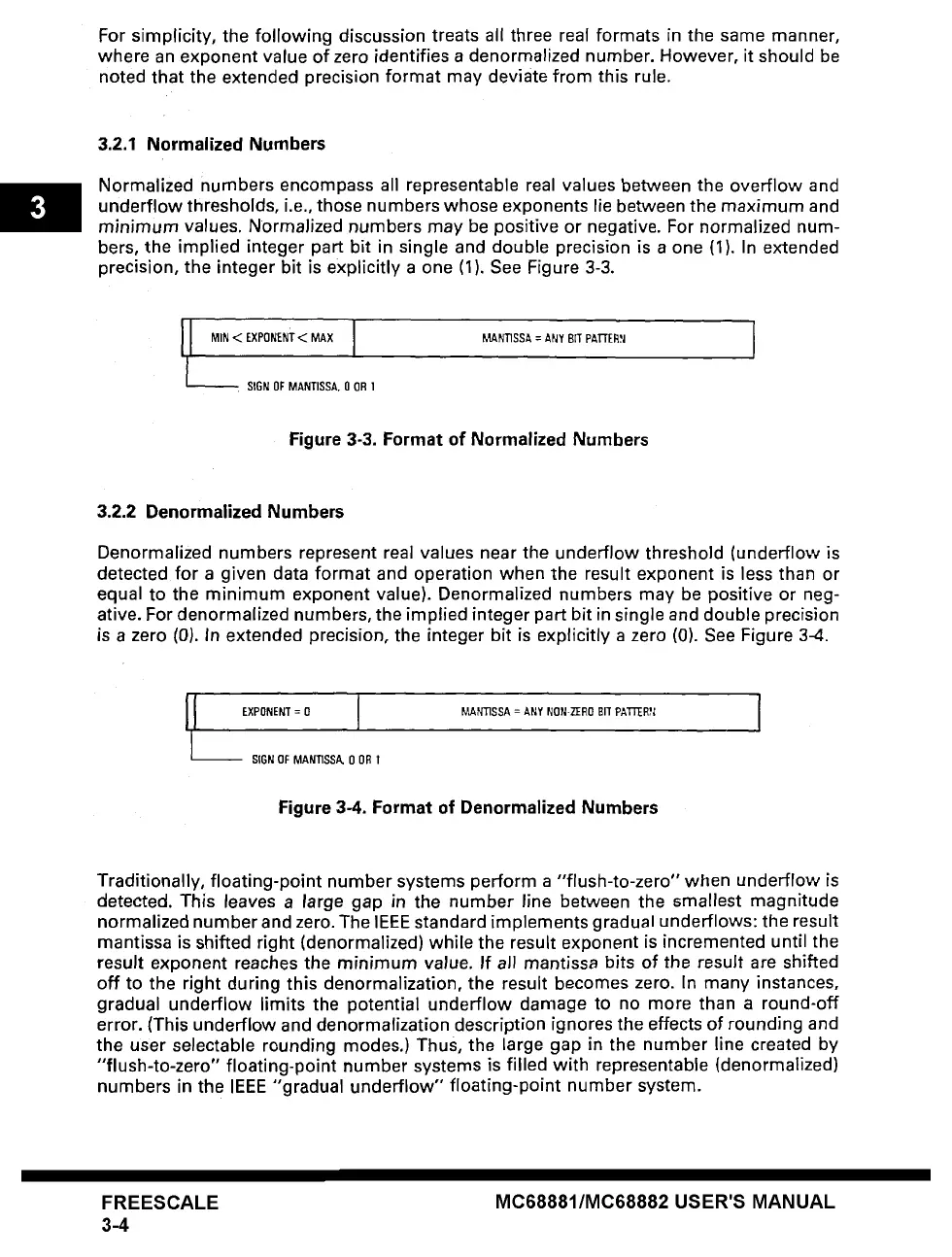
Normalized numbers encompass all representable real values between the overflow and
underflow thresholds, i.e., those numbers whose exponents lie between the maximum and
minimum values. Normalized numbers may be positive or negative. For normalized num-
bers, the implied integer part bit in single and double precision is a one (1). In extended
precision, the integer bit is explicitly a one (1). See Figure 3-3.
I MIN < EXPONENT < MAX I MANTISSA = ANY BiT PAI'[ER,'I I
I SIGN OF MANTISSA, 0 OR 1
Figure 3-3. Format of Normalized Numbers
3.2.2 Denormalized Numbers
Denormalized numbers represent real values near the underflow threshold (underflow is
detected for a given data format and operation when the result exponent is less than or
equal to the minimum exponent value). Denormalized numbers may be positive or neg-
ative. For denormalized numbers, the implied integer part bit in single and double precision
is a zero (0). in extended precision, the integer bit is explicitly a zero (0). See Figure 3-4.
I SIGN OF MANTISSA. 0 OR 1
Figure 3-4. Format of Denormalized Numbers
Traditionally, floating-point number systems perform a "flush-to-zero" when underflow is
detected. This leaves a large gap in the number line between the smallest magnitude
normalized number and zero. The IEEE standard implements gradual underflows: the result
mantissa is shifted right (denormalized) while the result exponent is incremented until the
result exponent reaches the minimum value. If all mantissa bits of the result are shifted
off to the right during this denormalization, the result becomes zero. In many instances,
gradual underflow limits the potential underflow damage to no more than a round-off
error. (This underflow and denormalization description ignores the effects of rounding and
the user selectable rounding modes.) Thus, the large gap in the number line created by
"flush-to-zero" floating-point number systems is filled with representable (denormalized)
numbers in the IEEE "gradual underflow" floating-point number system.
FREESCALE
3-4
MC68881/MC68882 USER'S MANUAL



 To Next Page