SECTION 3
OPERAND DATA FORMATS
The following paragraphs describe the MC68881/MC68882 (FPCP) operand data formats.
Seven data formats are supported: three signed binary integer formats, three binary float-
ing-point formats, and one packed binary-coded decimal (BCD) floating~point format. All
data formats are supported uniformly by all arithmetic and transcendental instructions.
These formats are as follows:
Byte Integer (B)
Word Integer (W) .
Long Word Integer (L)
Single Precision Real (S)
Double Precision Real (D)
Extended Precision Real (X)
Packed Decimal Real (P)
The capital letter in parentheses is the suffix added to an instruction in the assembly
language syntax to specify the data format of operands external to the FPCP. All data
formats are organized in memory consistently with the M68000 Family data organization,
i.e., the most significant byte is located at the lowest address (nearest $00000000), with
each successively less significant byte located at the next address (N + 1, N + 2, etc.). The
least significant byte is located at the highest address (nearest $FFFFFFFF).
Within the floating-point data formats, there are five types of numbers that can be
represented: normalized numbers, denormalized numbers, zeros, infinities, and not-a-
numbers (NANs). These data types are represented with special encodings corresponding
to each data format.
3.1 INTEGER DATA FORMATS
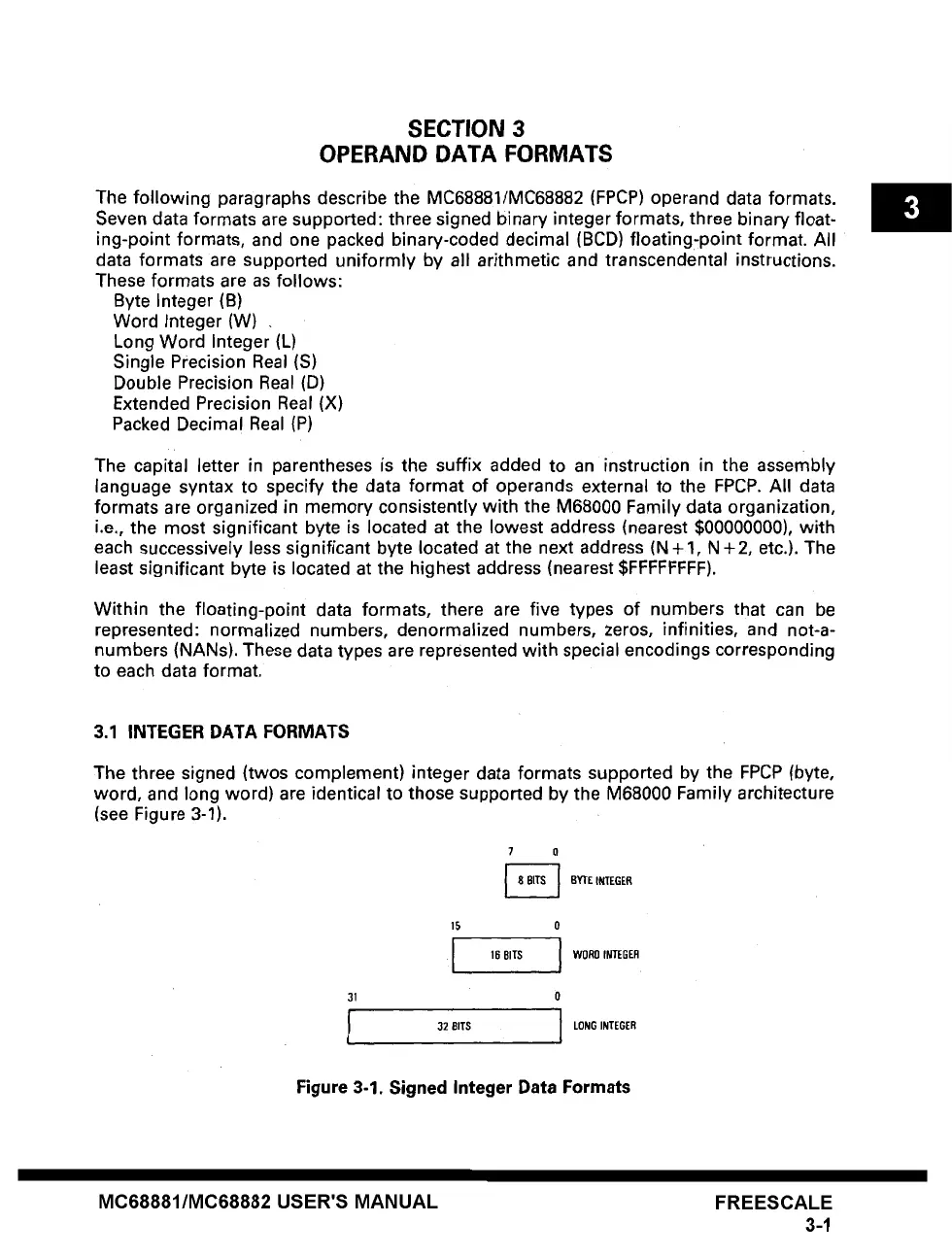
The three signed (twos complement) integer data formats supported by the FPCP (byte,
word, and long word) are identical to those supported by the M68000 Family architecture
(see Figure 3-1).
15
32 BITS
7 0
'~ BYTE INTEGER
0
16 BITS I WORO INTEGER
0
I LONG INTEGER
Figure 3-1. Signed Integer Data Formats
MC68881/MC68882 USER'S MANUAL FREESCALE
3-1



 To Next Page