3
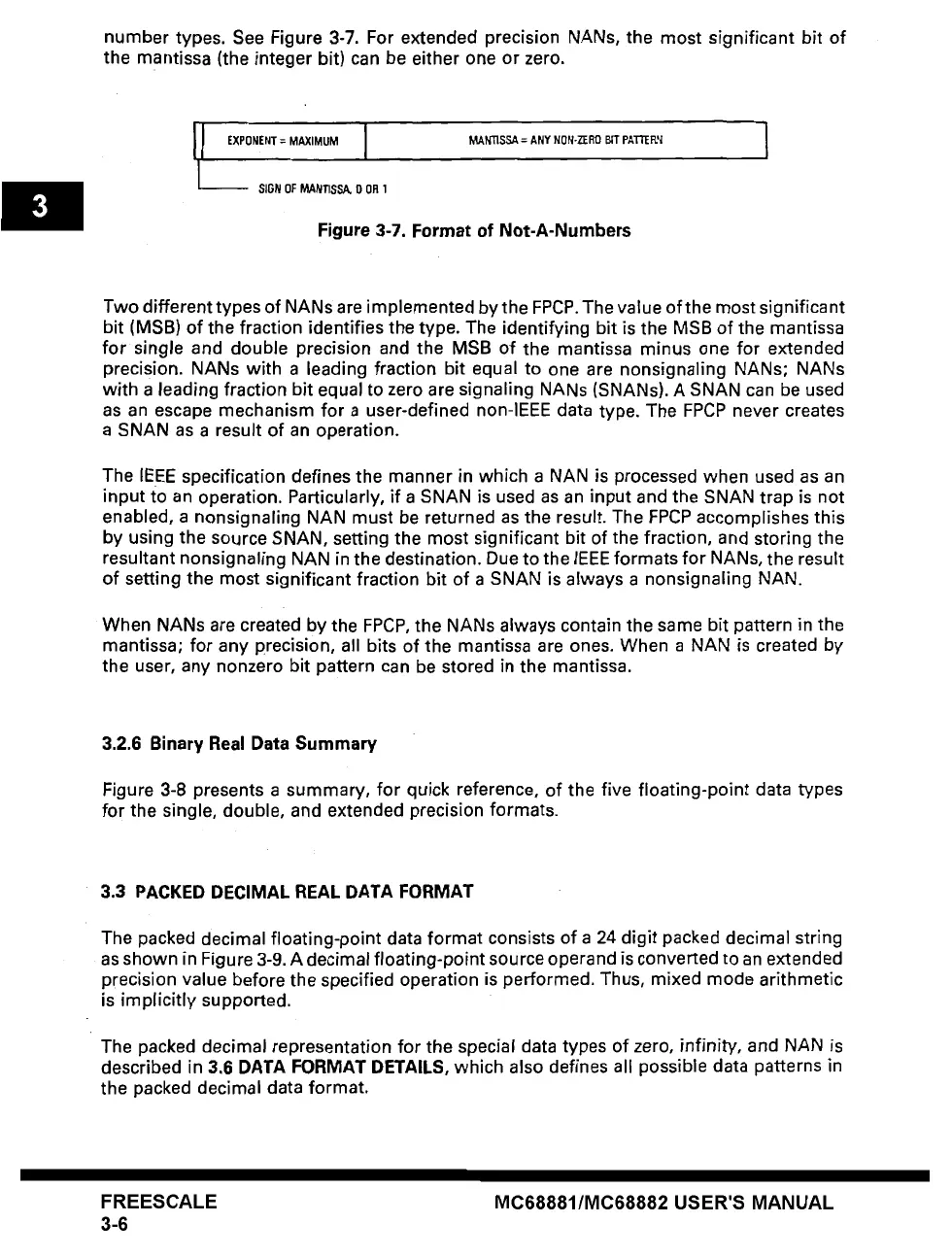
number types. See Figure 3-7. For extended precision NANs, the most significant bit of
the mantissa (the integer bit) can be either one or zero.
]l EXPONENT=MAXIMUM ] MANTISSA = ANY NON-7~ RO I~T PATTEP='~ I
~- SIGN OF MANTISS/~ 0 OR 1
Figure 3-7. Format of Not-A-Numbers
Two different types of NANs are implemented bythe FPCP. The value of the most significant
bit (MSB) of the fraction identifies the type. The identifying bit is the MSB of the mantissa
for single and double precision and the MSB of the mantissa minus one for extended
precision. NANs with a leading fraction bit equal to one are nonsignaling NANs; NANs
with a leading fraction bit equal to zero are signaling NANs (SNANs). A SNAN can be used
as an escape mechanism for a user-defined non-lEEE data type. The FPCP never creates
a SNAN as a result of an operation.
The IEEE specification defines the manner in which a NAN is processed when used as an
input to an operation. Particularly, if a SNAN is used as an input and the SNAN trap is not
enabled, a nonsignaling NAN must be returned as the result. The FPCP accomplishes this
by using the source SNAN, setting the most significant bit of the fraction, and storing the
resultant nonsignaling NAN in the destination. Due to the IEEE formats for NANs, the result
of setting the most significant fraction bit of a SNAN is always a nonsignaling NAN.
When NANs are created by the FPCP, the NANs always contain the same bit pattern in the
mantissa; for any precision, all bits of the mantissa are ones. When a NAN is created by
the user, any nonzero bit pattern can be stored in the mantissa.
3.2.6 Binary Real Data Summary
Figure 3-6 presents a summary, for quick reference, of the five floating-point data types
for the single, double, and extended precision formats,
3.3 PACKED DECIMAL REAL DATA FORMAT
The packed decimal floating-point data format consists of a 24 digit packed decimal string
as shown in Figure 3-9. A decimal floating-point source operand is converted to an extended
precision value before the specified operation is performed. Thus, mixed mode arithmetic
is implicitly supported.
The packed decimal representation for the special data types of zero, infinity, and NAN is
described in 3.6 DATA FORMAT DETAILS, which also defines all possible data patterns in
the packed decimal data format.
FREESCALE
3-6
MC68881/MC68882 USER'S MANUAL



 To Next Page