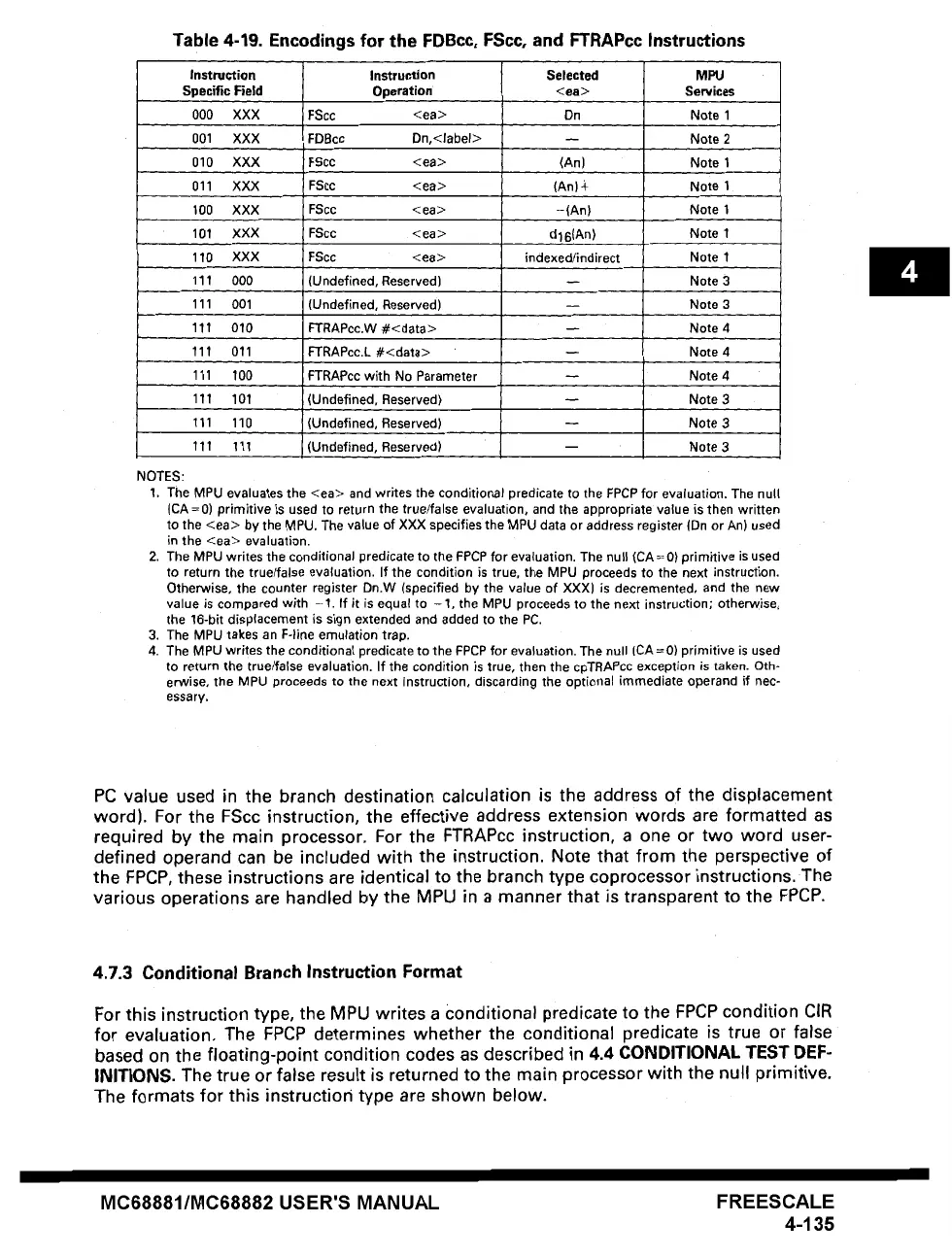
Table 4-19. Encodings for the FDBcc, FScc, and FTRAPcc Instructions
Instruction Instruction Selected MPU
Specific Field Operation <ea> Services
000 XXX FScc
<ea> Dn Note 1
001 XXX , FDBcc Dn,<label> -- Note 2
010 XXX FScc <ea>
011 XXX FScc <ea>
100 XXX FScc <ea>
101 XXX FSec <ea>
110 XXX FScc <ea>
111 000 (Undefined, Reserved)
111 001 (Undefined, Reserved)
111 010 FTRAPcc.W #<data>
(An) Note 1
(An) -~ Note 1
- (An) Note 1
d16{An) Note 1
indexed/indirect Note 1
--
Note 3
--
Note 3
--
Note 4
111 011 FTRAPcc.L #<data> Note 4
111 100 FTRAPcc with No Parameter -- Note 4
111 101 (Undefined, Reserved) -- Note 3
111 110 (Undefined, Reserved) -- Note 3
111 111 (Undefined, Reserved) -- Note 3
NOTES:
1. The MPU
evaluates the <ea> and writes the conditional predicate to the FPCP for evaluation. The null
(CA =0) primitive is used to return the true/false evaluation, and the appropriate value is then written
to the <ea> by the MPU. The value of XXX specifies the MPU data or address register (Dn or An) used
in the <ea> evaluation.
The MPU writes the conditional predicate to the FPCP for evaluation. The null (CA=0) primitive is used
to return the true/false evaluation. If the condition is true, the MPU proceeds to the next instruction.
Otherwise, the counter register Dn.W
(specified
by the value of XXX) is decremented, and the new
value is
compared
with - 1. If it is equal to - 1, the MPU proceeds to the next instruction; otherwise,
the 16-bit disp(acement is sign extended and added to the PC.
The MPU takes an F-line emulation trap.
The MPU writes the conditional predicate to the FPCP for evaluation. The null (CA=0) primitive is used
to return the true/false evaluation. If the condition is true, then the cpTRAPcc exception is taken. Oth*
erwise, the MPU proceeds to the next instruction, discarding the optional immediate operand if nec-
essary.
PC value used in the branch destination calculation is the address of the displacement
word). For the FScc instruction, the effective address extension words are formatted as
required by the main processor. For the FTRAPcc instruction, a one or two word user-
defined operand can be included with the instruction. Note that from the perspective of
the FPCP, these instructions are identical to the branch type coprocessor instructions. The
various operations are handled by the MPU in a manner that is transparent to the FPCP.
4.7.3 Conditional Branch Instruction Format
For this instruction type, the MPU writes a Conditional predicate to the FPCP condition CIR
for evaluation. The FPCP determines whether the conditional predicate is true or false
based on the floating-point condition codes as described in 4.4 CONDITIONAL TEST DEF-
INITIONS. The true or false result is returned to the main processor with the null primitive.
The formats for this instruction type are shown below.
MC68881/MC68882 USER'S MANUAL FREESCALE
4-135



 To Next Page