7
c. There is an FPCP service request (for example, to evaluate the effective address
and transfer data between the effective address and the FPCP). The FPCP may also
request that the MPU query the coprocessor after the service is performed.
d. The MPU is not needed for further processing of the coprocessor instruction. Com-
munication is terminated, and the MPU is free to begin execution of the next
instruction. If the MPU is in the trace mode, the MPU does not take the trace
exception until the FPCP completes the processing of the coprocessor instruction.
Each FPCP instruction type has specific requirements based upon this simplified protocol.
The main processor requests required for each FPCP instruction are described in 4.7
INSTRUCTION ENCODING DETAILS. All FPCP main processor service requests (response
primitives) are described in the following paragraphs. In addition, the dialog used by the
MPU and the FPCP during the execution of each instruction is detailed in 7.5 INSTRUCTION
DIALOGS.
7.4.2 Response Primitives
Data read from the FPCP coprocessor interface response register is referred to as a primitive.
Although the M68000 Family coprocessor interface defines 18 response primitives, the
FPCP only uses six of those primitives. For additional information on the complete set of
response primitives and how they are serviced; refer to the appropriate processor user's
manual. The following paragraphs summarize all FPCP response primitives and how they
are used.
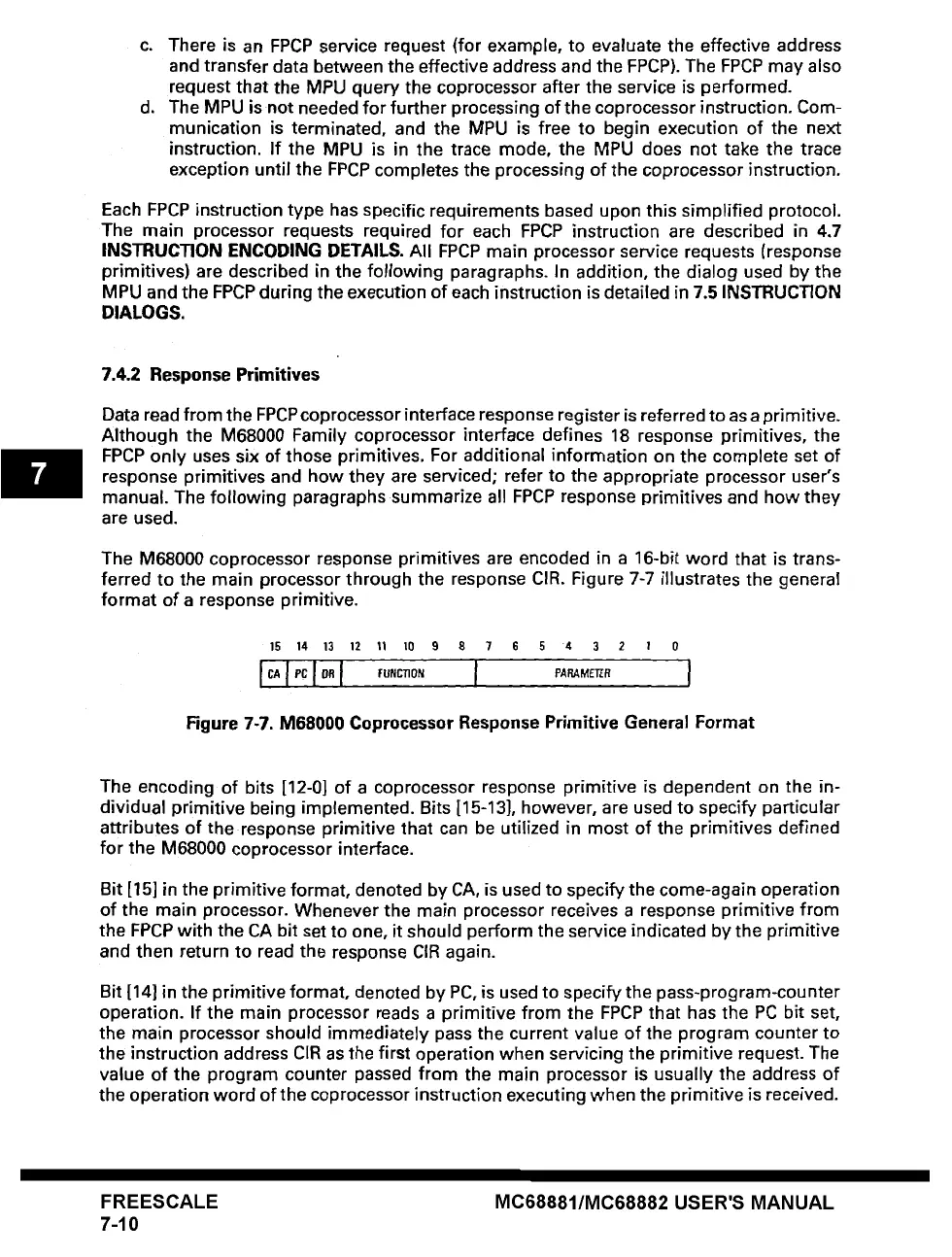
The M68000 coprocessor response primitives are encoded in a 16-bit word that is trans-
ferred to the main processor through the response CIR. Figure 7-7 illustrates the general
format of a response primitive.
15 14 13 12 11 I0 9 8 7 6 5 4 3 2 ! 0
ICAI PCIDR I FUNCTION I PARAMETER I
Figure 7-7. M68000 Coprocessor Response Primitive General Format
The encoding of bits [12-0] of a coprocessor response primitive is dependent on the in-
dividual primitive being implemented. Bits [15-13], however, are used to specify particular
attributes of the response primitive that can be utilized in most of the primitives defined
for the M68000 coprocessor interface.
Bit [15] in the primitive format, denoted by CA, is used to specify the come-again operation
of the main processor. Whenever the main processor receives a response primitive from
the FPCP with the CA bit set to one, it should perform the service indicated by the primitive
and then return to read the response CIR again.
Bit [14] in the primitive format, denoted by PC, is used to specify the pass-program-counter
operation. If the main processor reads a primitive from the FPCP that has the PC bit set,
the main processor should immediately pass the current value of the program counter to
the instruction address CIR as the first operation when servicing the primitive request. The
value of the program counter passed from the main processor is usually the address of
the operation word of the coprocessor instruction executing when the primitive is received.
FREESCALE
7-10
MC68881/MC68882 USER'S MANUAL



 To Next Page