User Manual corpuls
3
Operation – Monitoring and Diagnosis
ENG - Version 2.1 – P/N 04130.2 119
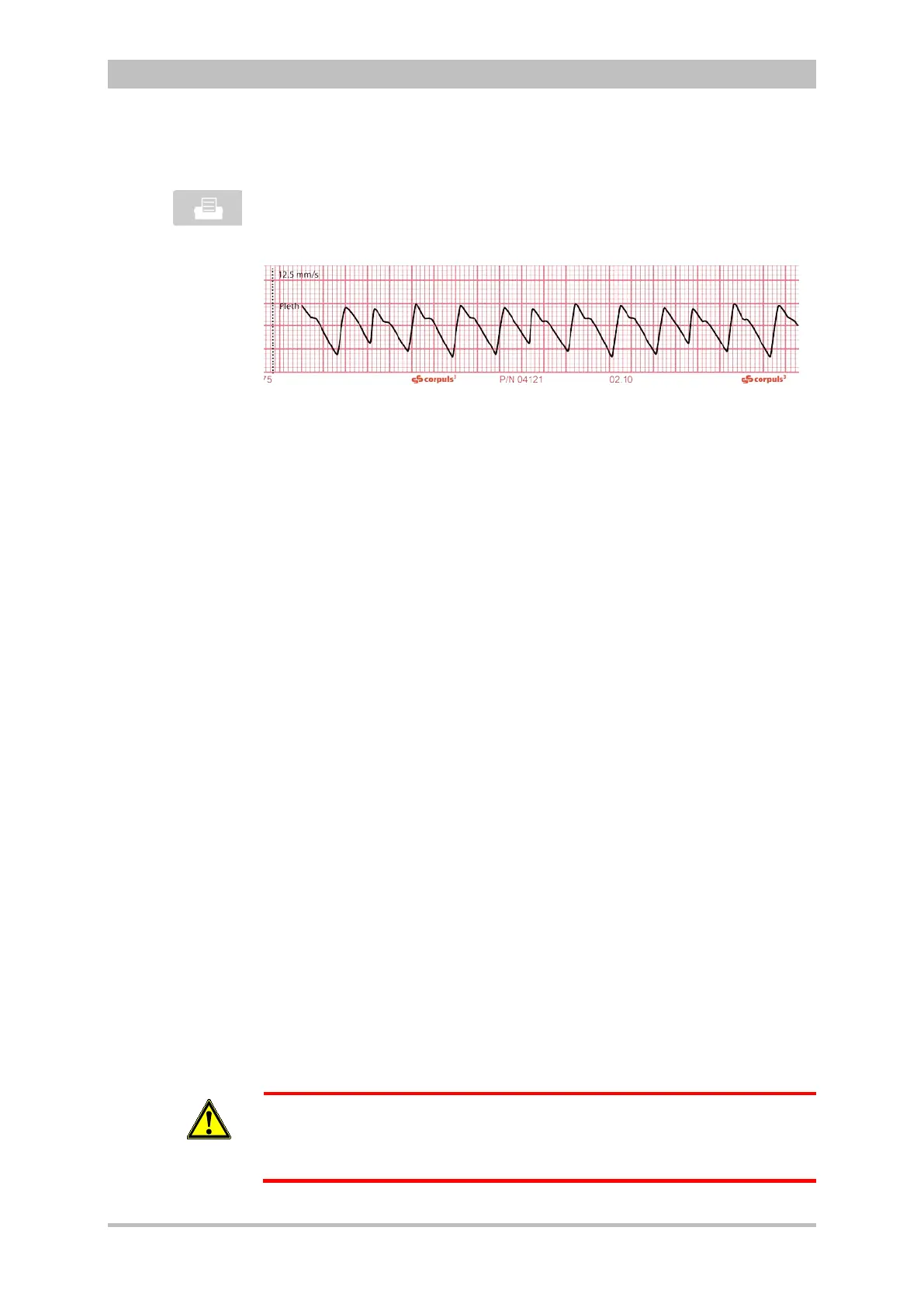
The pleth curve can be printed out with the integrated printer. See chapter 7.1.3
Printer settings, p. 143 for more information on configuring the printout.
Press the Print key to start or stop real-time printing.
Fig. 6-20 Pleth monitoring, section of a printout
Stability of measured SpO2 values is in general an indicator for good signal
quality. The stability of the measured values is influenced by the averaging
mode used. The longer the averaging time, the more stable the measured
values tend to become. This is due to a dampened response as the signal is
averaged over a longer period of time than this would be the case with shorter
averaging times. Longer averaging times delay the response of the oximeter
and reduce the measured variations of SpO2 and pulse rate.
The FastSat® mode tracks rapid changes in arterial SpO
2
saturation with high
fidelity. This allows for even more accurate and safe patient monitoring during
the intubation phase.
The sensitivity of the oximeter can be adjusted to the needs of the particular
patient monitoring situation in three levels (called modes in the following). The
following modes are available:
• Mode "Normal Sensitivity": This is the recommended sensitivity for typical
monitoring situations in which patients are monitored continuously, as e.g.
intensive care units.
• Mode "Adaptive Probe Off Detection (APOD)": This is the recommended
sensitivity for situations where there is a high probability of the sensor
becoming detached from the patient. It is also the suggested mode for care
areas where patients are not visually monitored continuously. APOD offers
a safe and fast detection of erroneous pulse rate and arterial oxygen
saturation readings when a sensor becomes inadvertently detached from a
patient due to excessive movement.
• Mode "Maximum Sensitivity (MAX)": This level of sensitivity is
recommended for patients with low perfusion in general or when the low
perfusion message is displayed on the screen in APOD or normal
sensitivity mode. This mode is only recommended for care areas where
patients are continuously monitored visually. When a sensor becomes
detached from a patient, it will have compromised protection against
erroneous pulse rate and arterial saturation readings.
Warning
When using the maximum sensitivity mode (MAX), the sensor-off-detection
may be compromised. If the device is in this mode and the sensor becomes
detached from the patient, false readings may occur due to environmental
noise such as light, vibration and excessive air movement.
Printing the
plethysmogram


 To Next Page