EasyManua.ls Logo

HP 262SA - Page 56

HP 262SA
390 pages
Print Icon
To Next Page IconTo Next Page
To Previous Page IconTo Previous Page
Loading...
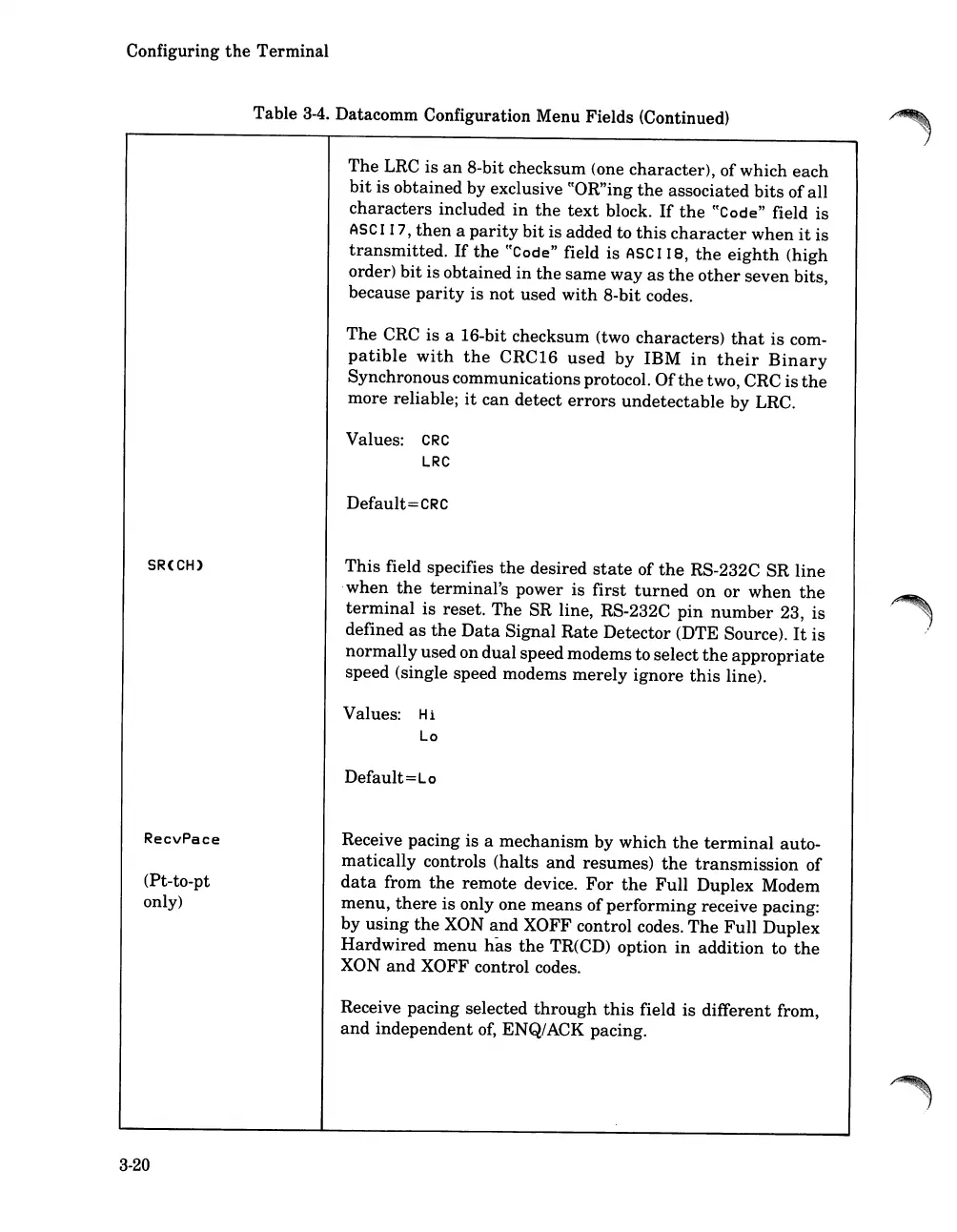
Configuring
the
Terminal
Table
3-4.
Datacomm Configuration Menu Fields (Continued)
The
LRC
is
an
8-bit checksum (one
character),
of which
each
bit
is obtained by exclusive tcOR"ing
the
associated
bits
of
all
characters
included
in
the
text
block.
If
the
((Code"
field is
ASCI
17,
then
a
parity
bit
is
added to
this
character
when
it
is
transmitted.
If
the
((Code"
field is ASC I
18,
the
eighth
(high
order)
bit
is obtained
in
the
same
way
as
the
other
seven bits,
because
parity
is
not
used
with
8-bit codes.
The
CRC is a 16-bit checksum (two
characters)
that
is
com-
patible
with
the
CRC16
used
by
IBM
in
their
Binary
Synchronous communications protocol.
Of
the
two, CRC is
the
more reliable;
it
can
detect
errors
undetectable
by LRC.
Values:
CRC
LRC
Default=CRC
SR(CH)
RecvPace
(Pt-to-pt
only)
3-20
This
field specifies
the
desired
state
of
the
RS-232C
SR
line
'when
the
terminal's power
is
first
turned
on
or
when
the
terminal
is
reset.
The
SR line, RS-232C
pin
number
23, is
defined
as
the
Data
Signal
Rate
Detector (DTE Source).
It
is
normally
used on
dual
speed modems to select
the
appropriate
speed (single speed modems
merely
ignore
this
line).
Values:
Hi
La
Default=Lo
Receive pacing is a
mechanism
by which
the
terminal
auto-
matically
controls
(halts
and
resumes)
the
transmission
of
data
from
the
remote device.
For
the
Full
Duplex Modem
menu,
there
is
only one
means
of
performing
receive pacing:
by
using
the
XON
and
XOFF control codes.
The
Full
Duplex
Hardwired
menu
has
the
TR(CD) option
in
addition
to
the
XON
and
XOFF control codes.
Receive pacing selected
through
this
field is different from,
and
independent
of,
ENQ/ACK
pacing.

Table of Contents

Related product manuals