Newtec Proprietary
Confidentiality: Unrestricted
V1.0
140/314
Data Interfaces MDM6000 Satellite Modem
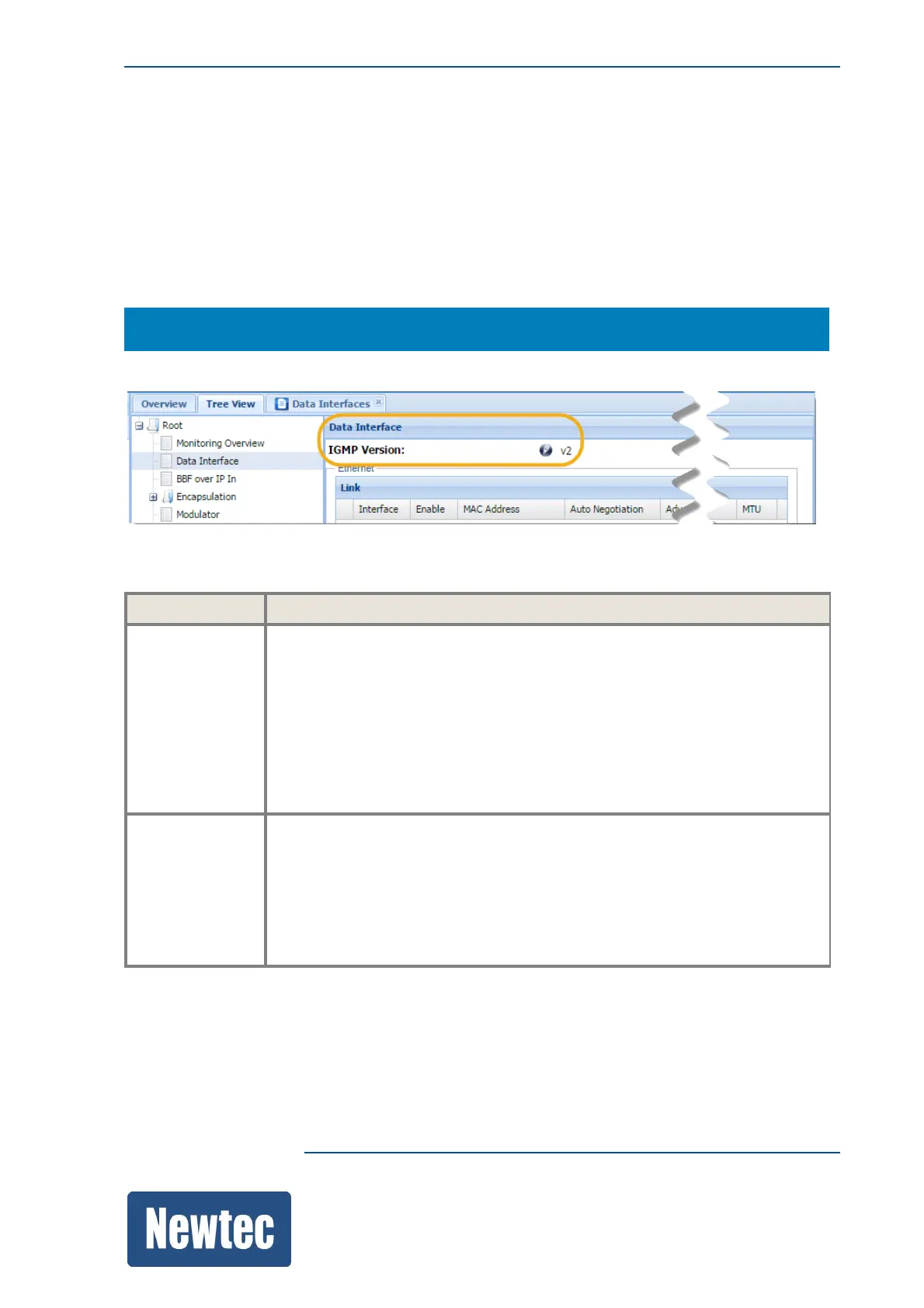
13.2.2 IGMP Version
Multicasting allows one computer on the Internet to send content to multiple other computers that
have identified themselves as interested in receiving the originating "computer's" content.
Internet Group Management Protocol (IGMP) is an Internet protocol that provides a way for an
Internet computer to report its Multicast group membership to adjacent routers.
IGMP registers dynamically individual hosts in a multicast group on a particular LAN segment.
MDM6000 >> Data Interface >> IP Interface
Configuration
Selection Description
IGMP v2 Provides the basic query response mechanism that allows the Multicast
router to determine which Multicast groups are active and other processes
that enable hosts to join and leave a Multicast group.
Furthermore it provides such capabilities as the IGMP leaves process,
group-specific queries and an explicit maximum response time field.
IGMPv2 also adds the capability for routers to elect the IGMP querier without
dependence on the multicast protocol to perform this task.
Please refer to RFC 2236 document that defines the IGMPv2.
IGMP v3 Provides for source filtering, which enables a multicast receiver host to signal
to a router which groups it wants to receive multicast traffic from, and from
which sources this traffic is expected. In addition, IGMPv3 supports the link
local address 224.0.0.22, which is the destination IP address for IGMPv3
membership reports; all IGMPv3-capable multicast routers must listen to this
address.
Please refer to RFC 3376 document that defines the IGMPv3.


 To Next Page