Newtec Proprietary
Confidentiality: Unrestricted
V1.0
197/314
Feature Descriptions MDM6000 Satellite Modem
14.7.1 ModCods in Satellite Communication
Data transferred via a satellite is modulated and coded at the sending side and demodulated and
decoded at the receiving end.
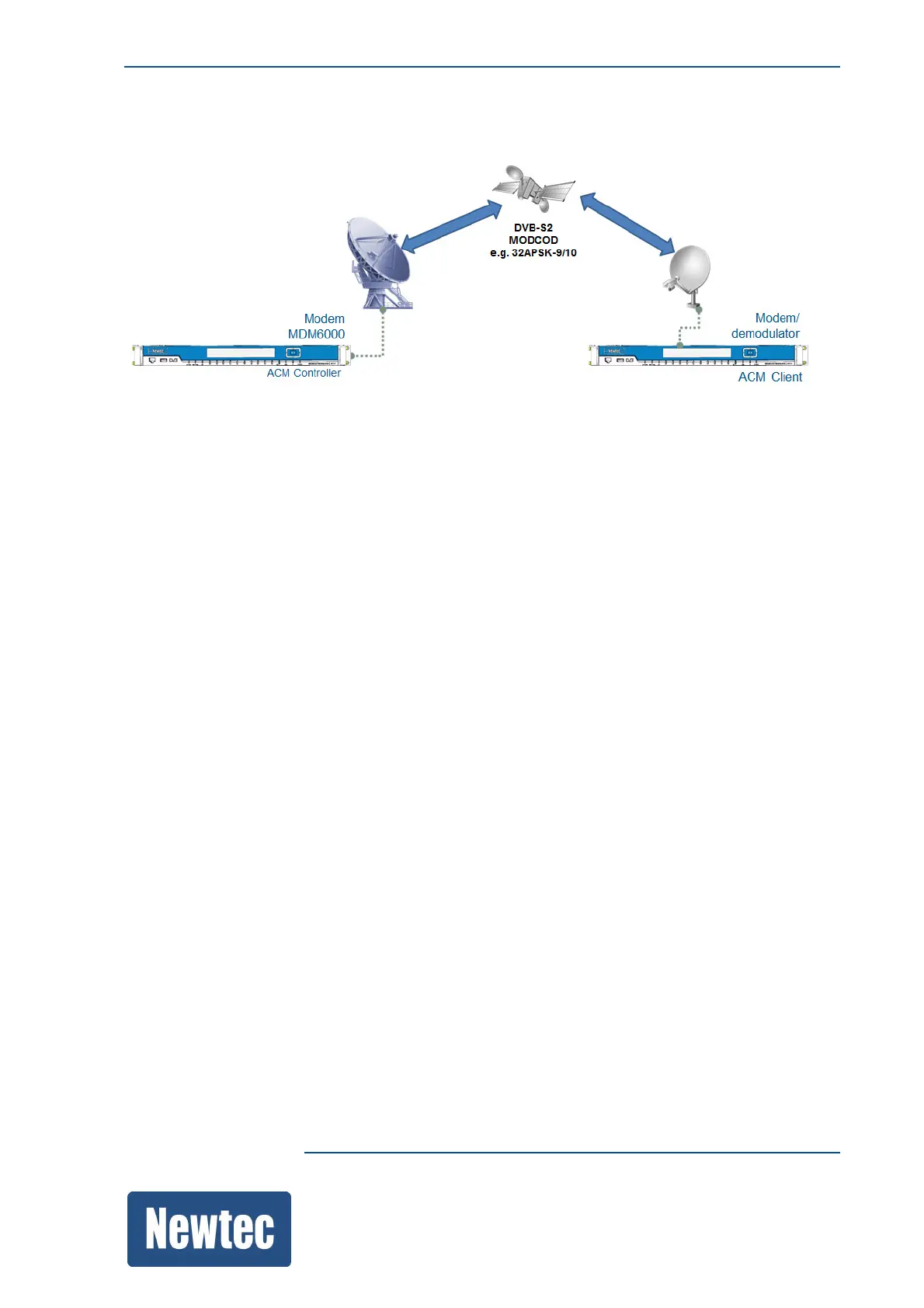
The used modulation and coding (FEC) is called the ModCod. Each combination of a specific
modulation and coding has a certain spectral efficiency determining the data throughput. This
spectral efficiency refers to the amount of information that can be transmitted over satellite in a given
bandwidth, the larger the spectral efficiency, the more information can be send over the satellite link
in the same bandwidth.
• A high ModCod is linked to a high data rate but requires a good signal-to-noise ratio at the
receivers end;
• A low ModCod functions with a lower signal-to-noise ratio at receivers end but has a lower data
rate.
As an example: the ModCod 32 APSK-9/10 has a spectral efficiency of 4.45 while ModCod
QPSK-1/4 has a spectral efficiency of 0.49.
In the S2 extension mode there is an increased number of ModCods added to have an even better
performance, also taken into account linear operation.
14.7.2 Why ACM
An ACM system provides two major benefits:
• It always maximizes the throughput of a satellite link;
• It guarantees the availability of the link reception.
The circumstances in which satellite connections are active can change all the time, due to e.g.
changing weather conditions.


 To Next Page