Newtec Proprietary
Confidentiality: Unrestricted
V1.0
31/314
Block Diagram MDM6000 Satellite Modem
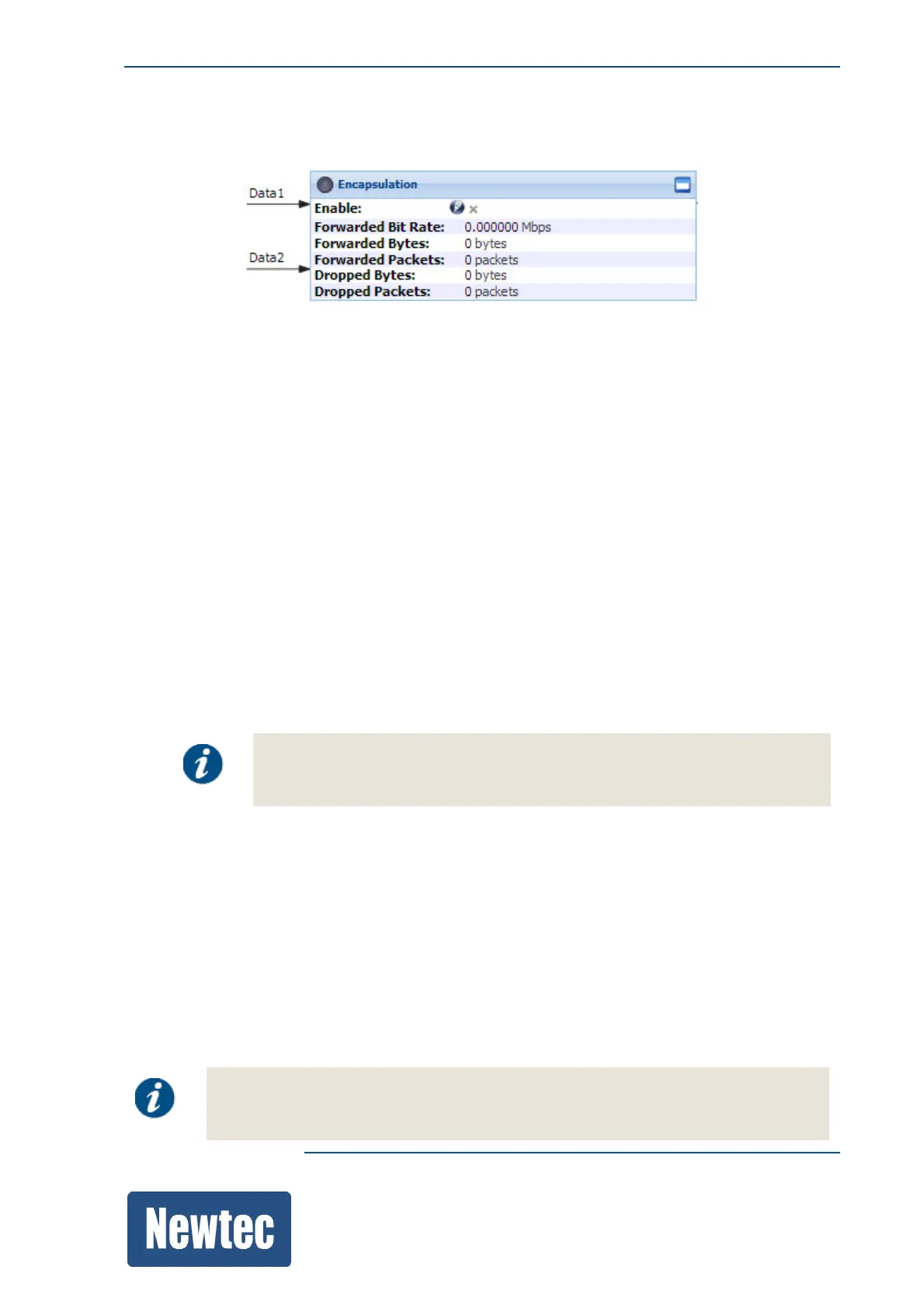
9.4 Encapsulation
Encapsulator Protocols
The data inserted can be encapsulated by the following protocols:
• Protocols that are optimized for the DVB-S2 standard.
Typically used in applications where bandwidth efficiency is important, such as IP backbone or IP
trunking applications.
– GSE (Generic Stream Encapsulation) is a standard DVB protocol and generates marginally
less overhead than XPE.
– XPE (Extended Performance Encapsulation) is a Newtec Proprietary protocol and in general
used in combination with Newtec products such as EL470, EL970 or other compatible
Newtec products.
Note that XPE was the forerunner of GSE because GSE was not standardized yet.
• Protocols that are compatible with the regular MPEG Transport Streams (DVB-S standard).
Typically used when compatibility with legacy receiver products or interoperability with low cost
IP receivers or set top boxes are necessary.
– MPE (Multi Protocol Encapsulation), was the first available protocol and therefor widely used
by many legacy receivers.
– ULE (Ultra Light Encapsulation), is a protocol that is more flexible and next to this offers an
increased efficiency (better throughput).
Note that the MPEG TS generated by the MDM6000 is not suitable for broadcast
transmission networks due to the absence of timing and signaling.
Channels
Once the encapsulation protocol is selected, the data is put into a channel (logical pipe) according to
the selected protocol.
• Incase of the GSE or XPE protocol an ISI (Input Stream Identifier) value must be defined for the
receiver site to be able to receive the data.
Next to this it is possible to use a label (MAC address or destination address) of the receiving
device.
• Incase of the MPE or ULE protocol an ISI and a PID (Program Identifier) is needed.
Next to this it is required for MPE to enter the label (MAC address) of the receiving device for
ULE a label is optional.
Note that to create a valid MPEG TS a PID must be defined (as it is an essential part
of the MPEG TS).


 To Next Page