Newtec Proprietary
Confidentiality: Unrestricted
V1.0
171/314
Feature Descriptions MDM6000 Satellite Modem
14.3 Equalink
Predistortion is applicable for a single carrier per transponder scenario.
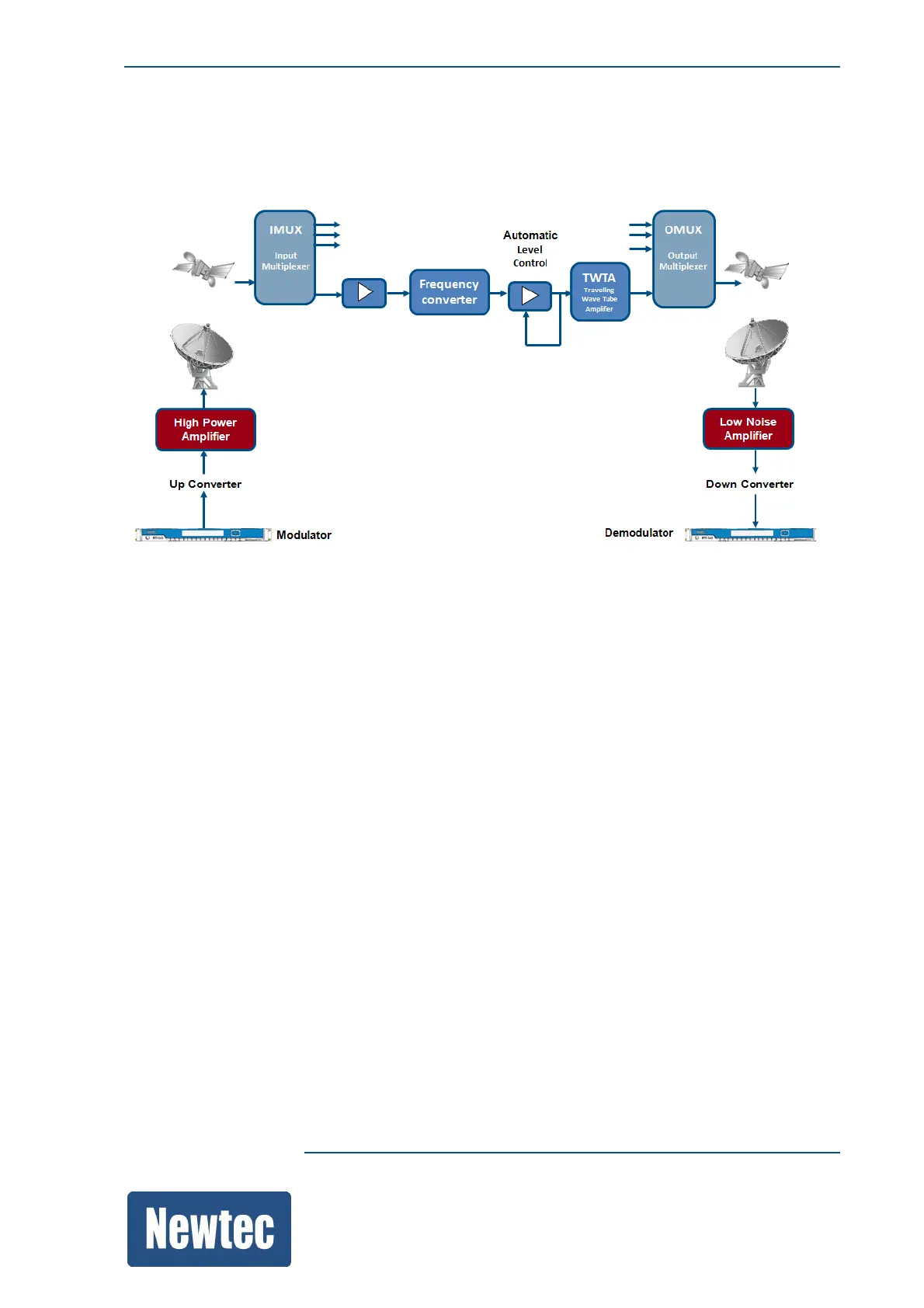
As shown on the figure above, a satellite payload contains an input multiplexing (IMUX), a traveling
wave tube amplifier (TWTA), and an output multiplexing (OMUX) filter. The IMUX filter selects the
input frequency band of your transponder (which is often a bit wider than your carrier). The TWTA
amplifies your signal. A side effect of this amplification is a widening of your carrier in frequency.
Therefore, the OMUX filter cuts away unwanted frequencies to avoid interference in other frequency
bands. Because the average power of the signal arriving at the TWTA varies (e.g. due to rain in the
uplink), a pre-gain stage is included in most payloads, performing automatic level control (ALC)
which keeps the drive level of the TWTA constant.
The goal of Equalink is to achieve the most efficient communication. At first, efficient communication
implies bandwidth efficient communication. To get most out of your transponder, your carrier
bandwidth should approach the bandwidth of the IMUX/OMUX filters. Because these filters operate
at very high frequencies in extreme conditions, imperfections in the filter response introduce linear
distortion into your signal.
Linear Equalink will compensate for this linear distortion so that you can further push your carrier
bandwidth.
Secondly, efficient communication implies power efficient communication. To get most out of your
transponder, your carrier signal should get amplified as much as possible by the TWTA, which is
achieved by increasing the drive level of the TWTA. Fortunately, Equalink can compensate for the
Non-Linear distortion that is introduced by the Non-Linear amplification, so that you can further push
the drive level.
Summarizing, Equalink optimizes the satellite link performance by counteracting distortion effects
(linear and Non-Linear distortion) in a satellite link.


 To Next Page