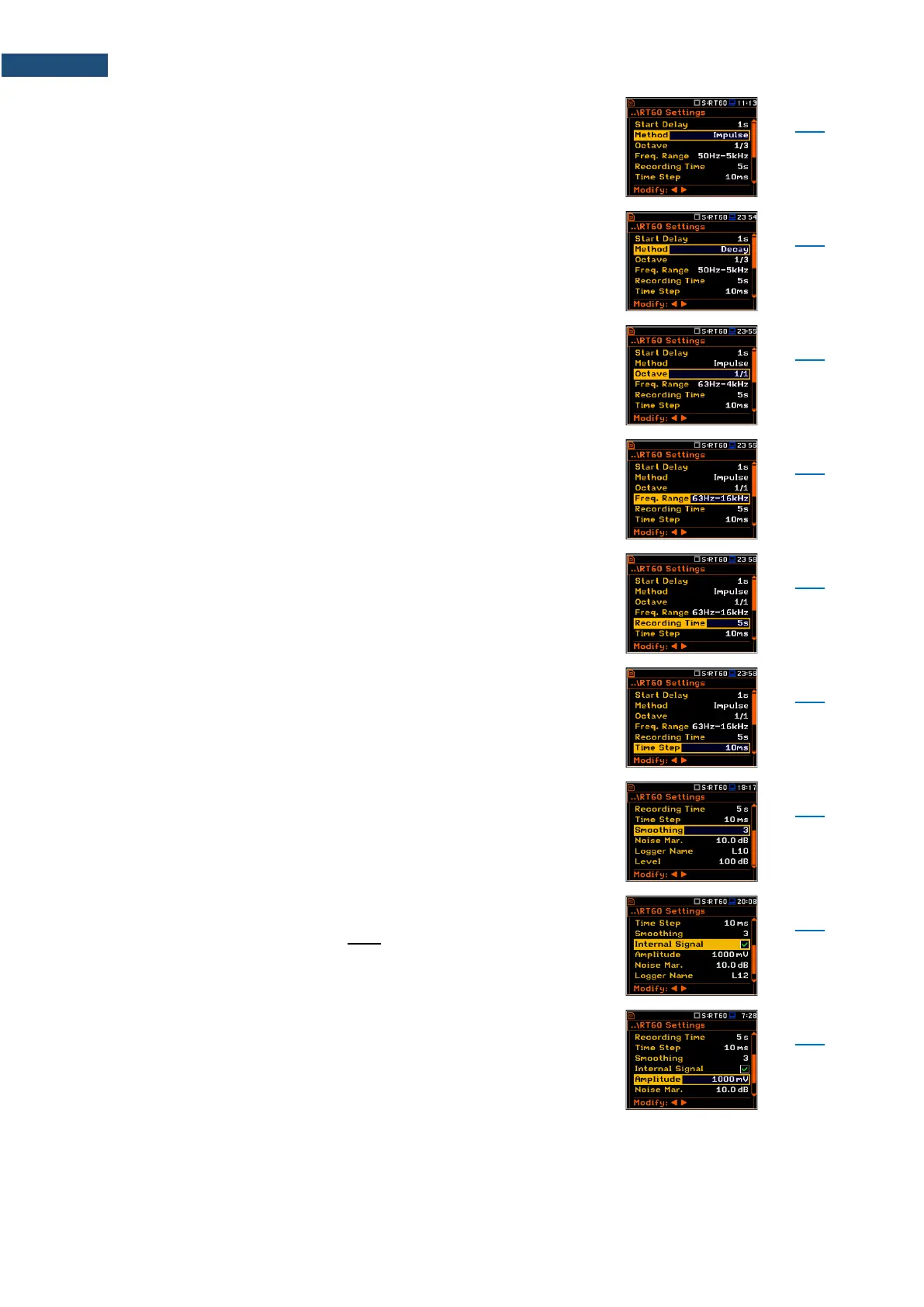
Method of RT60 calculation that uses the impulse sound
source (like pistol shot, petard explosion).
Method of RT60 calculation intended for measurements
when room is excited by broad or narrow band sound
noise source (usually pink noise).
Type of spectrum (1/1-octave or 1/3-octave) based on
which the RT60 analysis is performed.
Frequency range for RT60 calculations: 63Hz-4kHz (7
bands) and 63Hz-16kHz (9 bands) for 1/1-octave; 50Hz-
5kHz (21 bands) and 50Hz-20kHz (27 bands) for 1/3
octave.
Time of measurement data (sound pressure level decay
curve) registration during RT60 calculations: 1s .. 30 s.
Time-step of data registration (sound pressure level) in
the file during RT60 calculations: 2, 5, 10, 20, 50,
100 ms.
Process of smoothing of the raw reverberation time
results. This is used for better visualization of the RT60
results. The value of this parameter means number of
samples taken into consideration by the smoothing
algorithm. The higher is this number the smoother is a
graph.
Position that switches on generation of the pink noise to
feed the noise source in the Decay method. The signal is
transmitted to the pin 1 of the I/O connector.
Amplitude of the generated pink noise in the Decay
method.


 To Next Page