Teledyne API T703/T703U Calibrator Operation Manual Principles of Operation
207
PHOTOMETER ELECTRONIC OPERATION 9.6.4.
Photometer
Photometer
Lamp Heater
Motherboard
Photometer
Lamp Power
Supply
Sensor Inputs
PC 104 Bus
I
2
C Bus
Photometer
Pump
Thermistor Interface
Photometer
Detector
Preamp
A/D
Converter
RELAY PCA
I
2
C
Status
LED
y
PC 104
CPU Card
Disk on
Module
Photometer
Detector
Photometer
Sample Gas
Pressure
Sensor
Photometer
UV Lamp
Temperature
Photometer
Sample Gas
Temperature
Photometer M/R
Valve
(Located on O
3
Generator Assembly)
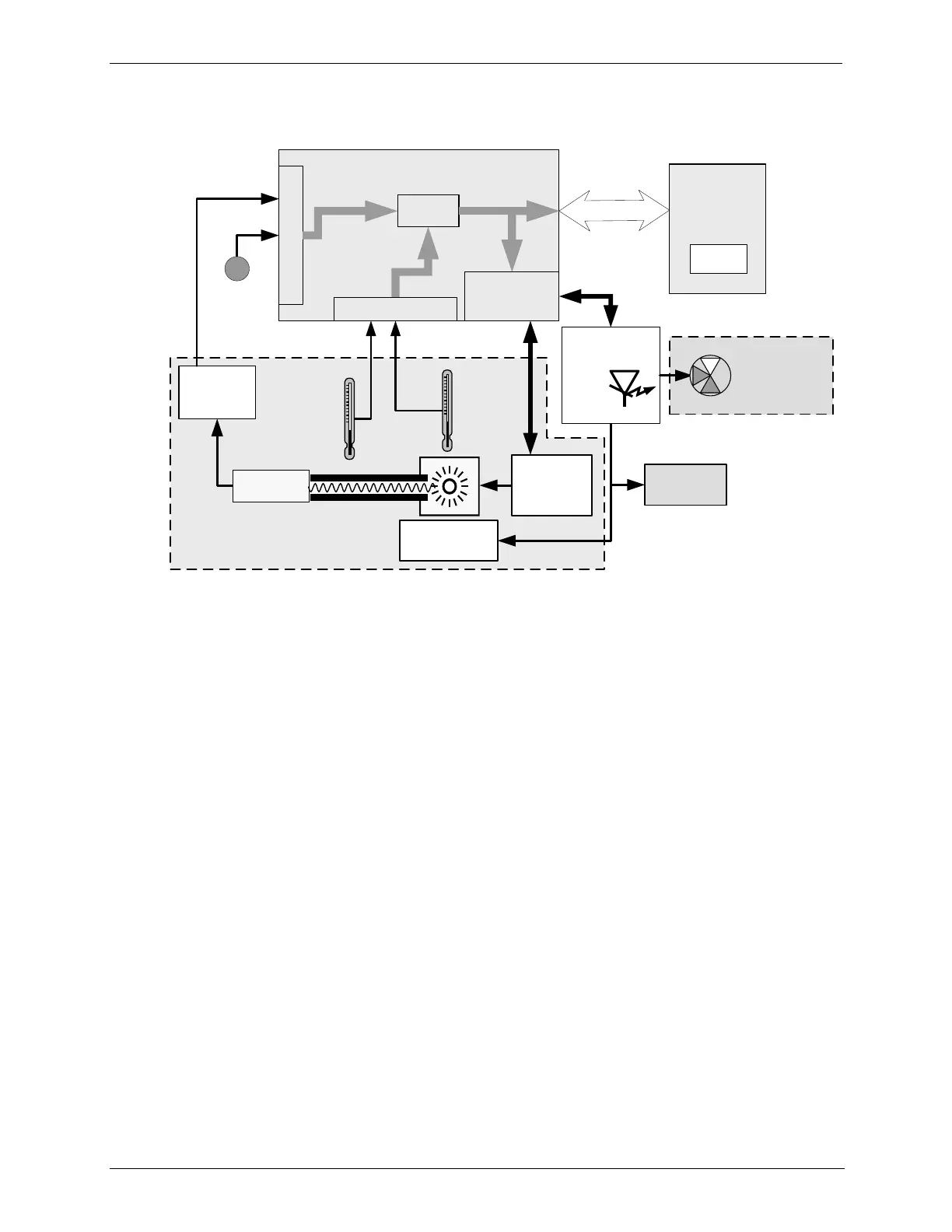
Figure 9-24: O
3
Photometer Electronic Block Diagram
Like the O
3
generator, the O
3
photometer and its subcomponents act as peripheral
devices operated by the CPU via the motherboard. Communications to and from
the CPU are handled by the motherboard.
Outgoing commands for the various devices such as the photometer pump, the
UV lamp power supply the U\V Lamp heater are issued via the I
2
C bus to
circuitry on the relay PCA which turns them ON/OFF. The CPU also issues
commands over the I
2
C bus that cause the relay PCA to cycle the
measure/reference valve back and forth.
Incoming date the UV light detector is amplified locally then converted to digital
information by the motherboard. Output from the photometers temperature
sensors is also amplified and converted to digital data by the motherboard. The
O
3
concentration of the sample gas is computed by the CPU using this data (along
with gas pressure and flow data received from the pressure sensors.
O
3
Photometer Temperature Control 9.6.4.1.
In order to operate at peak efficiency the UV lamp of the O
3
photometer is
maintained at a constant 58ºC. This is intentionally set at a temperature higher
than the ambient temperature of the operating environment to make sure that
local changes in temperature do not affect the UV Lamp. If the lamp temperature
falls below 56ºC or rises above 61ºC a warning is issued by the calibrator‟s CPU.
This temperature is controlled as described in the section on the relay PCA
(Section 9.2.3.2).



 To Next Page